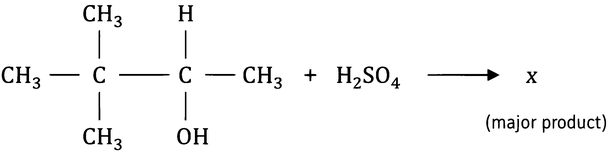
Concept:Acid-catalysed dehydration of an alcohol proceeds through carbocation formation and possible rearrangement to give the more stable alkene.Explanation:The given alcohol is 3,3-dimethyl-2-butanol: CH3−C(CH3)2−CH(OH)−CH3.In presence of H2SO4, the −OH group is protonated to form −OH2+, which leaves as water.CH3−C(CH3)2−CH(OH)−CH3+H+→CH3−C(CH3)2−CH(OH2+)−CH3Loss of water gives a secondary carbocation:CH3−C(CH3)2−CH+−CH3+H2OThis secondary carbocation rearranges by a 1,2-methyl shift to form a more stable tertiary carbocation:CH3−C(CH3)2−CH+−CH31,2-methyl shiftCH3−C+(CH3)−CH(CH3)−CH3Finally, loss of a proton from an adjacent carbon gives the more substituted alkene according to Saytzeff’s rule:CH3−C+(CH3)−CH(CH3)−CH3→CH3−C(CH3)=C(CH3)−CH3+H+Answer:The product X is 2,3-dimethyl-2-butene.Correct option: A.