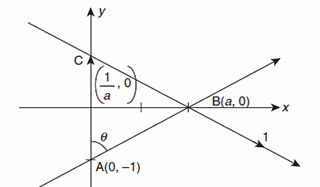
(A) We have x + y = |a| and ax – y = 1. Therefore, a1x−1y = 1 (a > 0) Now, x + y = a and a1x - y = 1
For intersection, at the first quadrant, we have a ∊ (mAB,mAC)mAB = a−00+1 = a1 And a ∊ (1 , ∫) a1 = a ⇒ a2 = 1 ⇒ a = 1 , - 1 Therefore, a = 1. mAB = 1 and mAC = ∞. Hence, the value of (32ac) = 32 Therefore, (A)→(Q). (B) If the point (α, β, γ) lies on the plane x + y + z = 2, then α + β + γ = 2. Now, a^ = α2+β2γ2αi^+βj^+γk^k^×(k^×a^) = (k^⋅a^)k^ - (k^⋅k^)a^ = α2+β2+γ2γk^ - α2+β2+γ2αi^+βj^+γk^ = - α2+β++γ2αi^+βj^ = 0 Therefore, αi + β j = 0 ⇒ α = 0 = β ⇒ γ = 2 Therefore, (B)→(P). (C) We have I = 0∫1(1−y2)dy + 1∫0(y2−1)dy = 0∫1(1−y2)dy + −0∫1(y2−1)dy0∫1(1−y2)dy + 0∫1(1−y2)dy = 20∫1(1−y2)dy = 20∫1(1−y2)dy = 2 (y−3y3)01 = 2(1−31) = 34I2 = 0∫11−xdx+−1∫01+xdx =
0∫11−xdx+−1∫01+xdx
= 20∫11−xdx20∫11−xdx = - 4 1∫0t2 dt = 4 0∫1t2 dt = 34 ⇒ I1 = I2 Therefore, 1 – x = t2 dx = −2t dt Therefore, (C)→(R). (D) We have sinAsinBsinC + cosAcosB = 1 Therefore, sin C = sinBsinA1−cosAcosB 0 < sin C ≤ 1 0 < sinBsinA1−cosAcosB ≤ 1 1 – cosAcosB ≤ sinAsinB 1 ≤ cosAcosB + sinAsinB cos(A – B) ≥ 1 Therefore, it is possible only if cos(A – B) = 1 A – B = 0 A = B Therefore, sin C = sin2a1−cos2A = 1 Therefore, (D)→(S).