(A) We have,y=(sinx)cosxlny=cosx×ln(sinx) Now, y′=y(cosxcotx−sinxlnsinx)y′=(sinx)cosx(cosxcotx−sinxlnsinx) Therefore,
I=0∫π/2(sinx)cosx(cosxcotx−ln(sinx)sinx)dx
I=0∫π/2d(sinx)cosx=(sinx)cosx0π/2=1
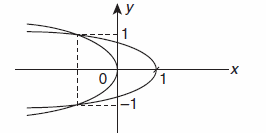
Therefore, (A)→(P) (B) For the curves, we have y2=4−xy2=−51(x−1) That is, −4x=−51(x−1)5x=4x−4x=−4y2=1⇒y=−1,1
Therefore, the area bounded is given by, −1∫1(1−5y2+4y2)dy=20∫1(1−y2)dy=2(y−3y3)01=2(1−31)=34 Therefore (B) → (S) (C) The point of intersection of the curve is y3=3x−1(lnx) and y=xx−1 is (1,0). Now, for the first curve, we have y′=3x−1(x1)+(3x−1lnxln3)y(1,0)′=1+0=1 and for the second curve, we have y′=(y+1)(1+lnx)y(1,0)′=1 Therefore, the angle between the curves is 0 . Therefore, (C)→(Q). (D) We have dxdy=x+y2⇒x+y=t1+dxdy=dxdt That is, dxdt−1=t2⇒dxdt=t2+1=tt+2⇒t+2tdt=dx⇒∫(t+2t+2−2)dt=∫dx+c⇒∫(1−t+22)dt=∫dx+c⇒t−2ln(t+2)=x+c⇒(x+y)−2ln(x+y+2)=x+c⇒1−2ln3=1+c[dxdy=x+y2 passes through (1,0)]⇒c=−2ln3⇒y−2ln(x+y+2)=−2ln3⇒y=2ln(3x+y+2) Therefore, x+y+z=3ey/2 Therefore, (D)→(R).