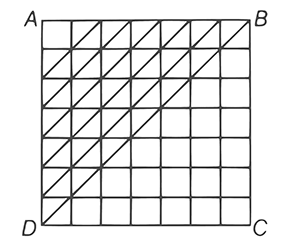
We can choose three squares in a diagonal line parallel to
BD in the
△ABD. Clearly, three squares in
△ABD and in a diagonal line parallel to
BD can be chosen in
3C3+4C3+5C3+6C3+7C3+8C3 ways
Similarly, in
△BCD the squares can be chosen parallel to
BD in an equal number of ways.
Hence, the total number of ways in which three squares can be chosen in a diagonal line parallel to
BD is
=2(3C3+4C3+5C3+6C3+7C3)+8C3(
∵BD is common to both the triangles) Similarly, squares can be chosen in a diagonal line parallel to
AC and hence the total number of favourable ways
=4(3C3+4C3+5C3+6C3+7C3)+2⋅8C3=392Hence, the required probability
=64C3392=64×63×62392×6=7447