Test Index
Wave Optics
Wave Optics

 CBSE Board Videos
© examsnet.com
Question : 29 of 31
Marks:
+1,
-0
Diffraction of light is bending of light around the corners of an object whose size is comparable with the wavelength of light. Diffraction actually defines the limits of ray optics. This limit for optical instruments is set by the wavelength of light. An experimental arrangement is set up to observe the diffraction pattern due to a single slit.Answer the following questions based on the above :(a) How will the width of central maximum be affected if the wavelength of light is increased ? (1)(b) Under what condition is the first minimum obtained ? (1)(c) Write two points of difference between interference and diffraction patterns. (2)OR(c) Two students are separated by a 7 m partition wall in a room 10 m high. If both light and sound waves can bend around obstacles, how is it that the students are unable to see each other even though they can converse easily ? (2)
[CBSE 2023 55/3/1]
Solution:
(a)Angular width of the central maximum (linear width ). It is proportional to , so if the wavelength is increased, the central maximum becomes wider.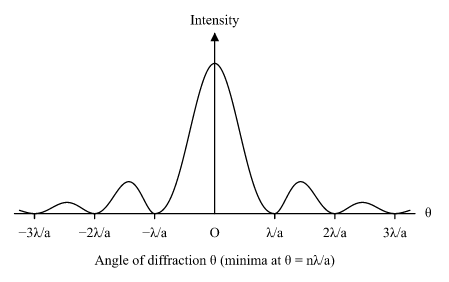 (b)The first minimum is obtained at the angle for which (i.e. ), where is the slit width. At this angle the path difference between the waves from the two edges of the slit is ; dividing the slit into two halves, each point in one half has a partner in the other half with path difference , so their contributions cancel.(c) Interference vs diffraction patterns:1. Interference: all bright fringes are of (nearly) equal width / equally spaced. Diffraction: the central maximum is twice as wide as the other maxima.2. Interference: all bright fringes have the same intensity. Diffraction: the intensity of the secondary maxima falls rapidly away from the central maximum.(Also: interference is the superposition of waves from two coherent sources; diffraction is the superposition of wavelets from different points of the same wavefront (single slit). Dark fringes in interference are perfectly dark; diffraction minima are not.)OR (c)Bending (diffraction) is noticeable only when the size of the obstacle or opening is comparable to the wavelength. The wall is m high in a m high room, so the opening above it is about m.Sound waves of ordinary speech have wavelengths of roughly to a few metres, comparable to this opening, so sound bends around the wall and the students can talk.Light has wavelength about m, extremely small compared with m, so its diffraction is negligible; light travels almost in straight lines and the students cannot see each other.
© examsnet.com
Go to Question: