Test Index
Wave Optics
Wave Optics

 CBSE Board Videos
© examsnet.com
Question : 28 of 31
Marks:
+1,
-0
(a) State Huygens' principle. How did Huygens explain the absence of the backwave ?OR(b) Use Huygens' principle to show reflection/refraction of a plane wave by (i) concave mirror, and (ii) a convex lens.
[CBSE 2023 55/3/1]
Solution:
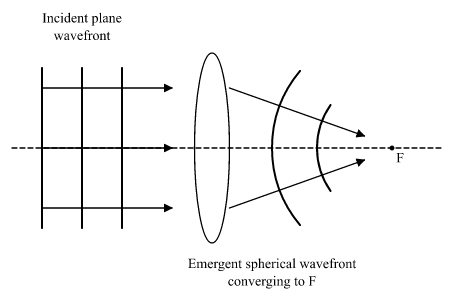
(a)Huygens' principle:(i) Each point of a wavefront is a source of secondary disturbance; the wavelets from these points spread out in all directions with the speed of the wave.(ii) The common tangent (forward envelope) to all these secondary wavelets at any later time gives the new position of the wavefront.Absence of the backwave:Drawing the envelope backwards would give a wave going back, which is not observed. Huygens explained this by assuming that the amplitude of the secondary wavelets is maximum in the forward direction and zero in the backward direction. With this assumption there is no backwave (the assumption was later justified by a more rigorous wave theory).OR (b)(i) Reflection of a plane wave by a concave mirror:A plane wavefront falls on a concave mirror. The central part of the wavefront reaches the mirror last, while the edges are reflected first. Constructing the secondary wavelets from the reflecting points, the reflected wavefront is spherical and converges to the focus F of the mirror.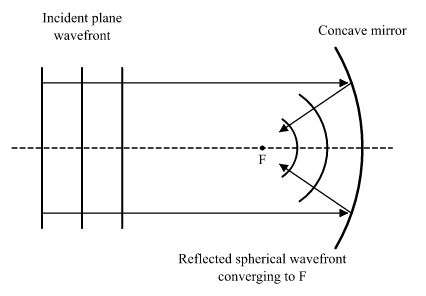 (ii) Refraction of a plane wave by a convex lens:A plane wavefront falls on a thin convex lens. The central part of the wavefront travels through the greatest thickness of glass, where light is slower, so it is delayed most. The emerging wavefront is therefore curved (spherical, concave towards the direction of travel) and converges to the focus F.
© examsnet.com
Go to Question: