Test Index
Wave Optics
Wave Optics

 CBSE Board Videos
© examsnet.com
Question : 30 of 31
Marks:
+1,
-0
Briefly explain how bright and dark fringes are formed on a screen due to the diffraction at a single slit. Hence, explain why the intensity at the bright fringes decreases sharply as their order () increases.
[CBSE 2022 55/4/3]
Solution:
Formation of fringes: a plane wavefront falls normally on a single slit LN of width . Every point of the wavefront in the slit acts as a source of secondary wavelets, and the light reaching a point P on the screen (at angle ) is the sum of the contributions from all parts of the slit with their proper phase differences.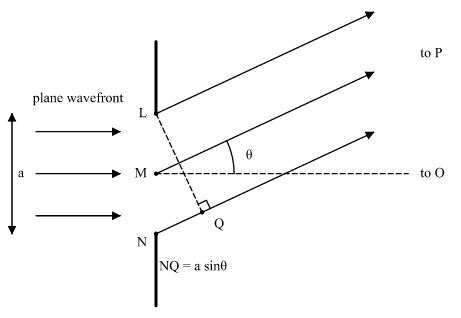 The path difference between the waves from the two edges is .Central maximum: at the centre O, ; all path differences are zero and all parts of the slit contribute in phase, so the intensity is maximum.Dark fringes (minima): when , divide the slit into two halves LM and MN. For every point in LM there is a point in MN whose path difference is , so their contributions are out of phase and cancel in pairs. The intensity is zero. In general, minima occur atBright fringes (secondary maxima): at (midway between the first two minima), divide the slit into three equal parts. The first two-thirds have a path difference between their ends; they cancel each other as above. Only the remaining one-third of the slit contributes, giving a bright fringe. In general, secondary maxima occur at
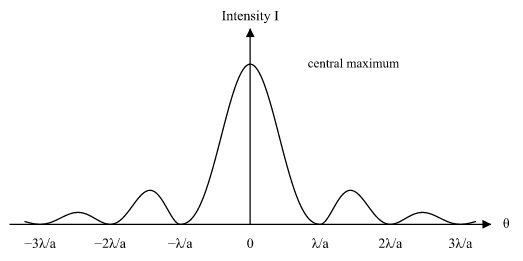 Why the intensity falls sharply with order : for the th secondary maximum the slit is divided into equal parts; the contributions of parts cancel in pairs and only one part, i.e. of the slit, contributes. So only of the slit contributes to the 1st, 2nd, 3rd ... maxima, while the whole slit contributes to the central maximum. Hence the intensity of the bright fringes decreases rapidly as increases.
© examsnet.com
Go to Question: