Test Index
Ray Optics and Optical Instruments
Ray Optics and Optical Instruments

 CBSE Board Videos
© examsnet.com
Question : 12 of 46
Marks:
+1,
-0
When light travels from an optically denser medium to an optically rarer medium, at the interface it is partly reflected back into the same medium and partly refracted to the second medium. The angle of incidence corresponding to an angle of refraction is called the critical angle () for the given pair of media. This angle is related to the refractive index of medium 1 with respect to medium 2.Refraction of light through a prism involves refraction at two plane interfaces. A relation for the refractive index of the material of the prism can be obtained in terms of the refracting angle of the prism and the angle of minimum deviation. For a thin prism, this relation reduces to a simple equation.Laws of refraction are also valid for refraction of light at a spherical interface. When an object is placed in front of a spherical surface separating two media, its image is formed. A relation between object and image distance, in terms of refractive indices of two media and the radius of curvature of the spherical surface can be obtained. Using this relation for two surfaces of a lens, 'lens maker formula' is obtained.(i) An object is placed in front of a convex spherical glass surface ( and radius of curvature ) at a distance of from it. As the object is moved slowly close to the surface, the image formed is :(A) always real(B) always virtual(C) first real and then virtual(D) first virtual and then real(ii) A double-convex lens, made of glass of refractive index , has focal length cm. The radius of curvature of its each face, is :(A) cm(B) cm(C) cm(D) cm(iii) A small bulb is placed at the bottom of a tank containing a transparent liquid (refractive index ) to a depth . The radius of the circular area of the surface of liquid, through which light from the bulb can emerge out, is . Then is :(A) (B) (C) (D) (iv) (a) A parallel beam of light is incident on a face of a prism with refracting angle . The angle of minimum deviation is found to be . The refractive index of the material of the prism is close to :(A) (B) (C) (D) OR(b) The angle of minimum deviation for a ray of light incident on a thin prism, made of crown glass () is . If the prism was made of dense flint glass () instead of crown glass, the angle of minimum deviation will :(A) decrease by (B) increase by (C) decrease by (D) increase by
[CBSE 2025 55/7/3]
Solution: 👈: Video Solution
(i)Refraction at a spherical surface: , with (air), , (object at distance ), positive (convex towards the object).The image is real () when , i.e. , and virtual when .At : , (real).As the object moves from towards the surface it passes (the first focal point, where the image is at infinity), and the image becomes virtual.Answer: Option C (first real and then virtual).(ii)Lens maker formula for a double-convex lens with , :, so cm.Answer: Option A ( cm).(iii)Light from the bulb leaves the liquid only where its angle of incidence at the surface is less than the critical angle . Rays at exactly graze the surface and fix the edge of the circle.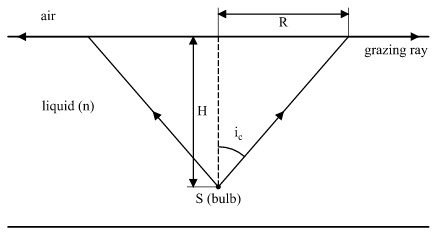 , so From the figure, Answer: Option A ().(iv)(a)Answer: Option B ().OR (b)For a thin prism, ; the angle is the same for both prisms.Crown glass: Flint glass: Change (an increase)Key point: The options come from comparing itself (); the deviation depends on , not on .Answer: Option D (increase by ).
© examsnet.com
Go to Question: