Test Index
Ray Optics and Optical Instruments
Ray Optics and Optical Instruments

 CBSE Board Videos
© examsnet.com
Question : 11 of 46
Marks:
+1,
-0
(a) Using the mirror equation and the formula of magnification, deduce that “the virtual image produced by a convex mirror is always diminished in size and is located between the pole and the focus.”OR(b) A convex lens of focal length cm, a concave lens of focal length cm and a third lens of unknown focal length are placed coaxially in contact. If the focal length of the combination is cm, find the nature and focal length of the third lens, if all lenses are thin. Will the answer change if the lenses were thick?
[CBSE 2025 55/7/3]
Solution: 👈: Video Solution
(a)Using the New Cartesian sign convention: for a convex mirror the focus is behind the mirror, so . A real object is in front of the mirror, so ; write .Position: Mirror equation givesBoth terms are positive, so : is positive, i.e. the image is behind the mirror (virtual).Also , so . Hence : the image lies between the pole P and the focus F.Size: From the mirror equation, . Magnification:Since and : . So the image is erect () and diminished () for every position of the object.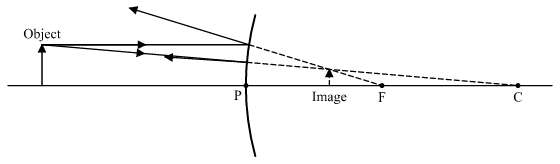 OR (b)Given: cm (convex), cm (concave), cm; Formula used: For thin lenses in contact, Solution: cmResult: The third lens is a convex (converging) lens of focal length cm.Thick lenses: Yes, the answer would change. The relation holds only for thin lenses in contact, where the separation between the lenses is negligible. Thick lenses have a finite separation between their optical centres, so the combined focal length depends on that separation as well and the formula no longer gives the correct value.
© examsnet.com
Go to Question: