Test Index
Ray Optics and Optical Instruments
Ray Optics and Optical Instruments

 CBSE Board Videos
© examsnet.com
Question : 13 of 46
Marks:
+1,
-0
(a) (i) Explain with the help of a labelled ray diagram the formation of final image by an astronomical telescope at infinity. Write the expression for its magnifying power.(ii) The total magnification produced by a compound microscope is . The magnification produced by the eyepiece is . When the microscope is focussed on a certain object, the distance between the objective and eyepiece is observed to be cm. Calculate the focal lengths of the objective and the eyepiece. (Given that the least distance of distinct vision cm)OR(b) (i) Two coherent light waves, each of intensity superpose each other and produce interference pattern on a screen. Obtain the expression for the resultant intensity at a point where the phase difference between the waves is . Write its maximum and minimum possible values.(ii) In a single slit diffraction experiment, the aperture of the slit is mm and the separation between the slit and the screen is m. A monochromatic light of wavelength nm is normally incident on the slit. Calculate the distance of (I) first order minimum, and (II) second order maximum, from the centre of the screen.
[CBSE 2025 55/7/3]
Solution: 👈: Video Solution
(a)(i)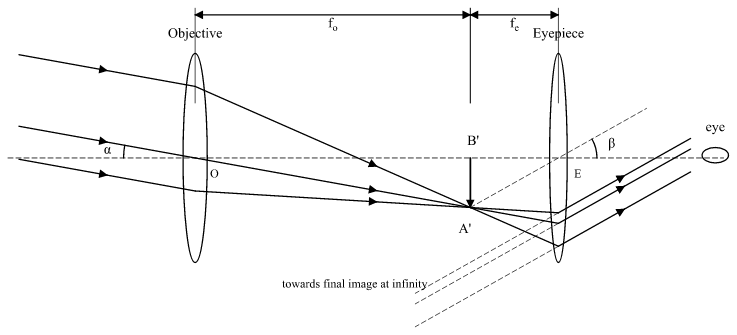 Parallel rays from a distant object, making an angle with the axis, fall on the objective (large focal length ). The objective forms a real, inverted, diminished image A'B' at its second focal point. The eyepiece is adjusted so that A'B' lies at its first focal point. The rays then leave the eyepiece parallel, making an angle with the axis, so the final image is formed at infinity (normal adjustment). It is inverted with respect to the object.Magnifying power: . With and ( = height of A'B'):Length of the telescope tube .(a)(ii)Given: , , cm, cm. The final image is taken at the least distance of distinct vision.Eyepiece: cmObject distance for the eyepiece ( cm): cmObjective: cm cm, so cm cmResult: cm, cmKey point: If the final image is taken at infinity instead, gives cm; the object for the eyepiece is still cm from it, so cm is unchanged.OR (b)(i)Let the two waves at the point be, By the principle of superposition,This is an oscillation of amplitude .Intensity (amplitude): and Maximum: Minimum: (b)(ii)Given: m, m, m(I) Minima: , so . For : m mm(II) Secondary maxima: , so . For : m mmResult: first minimum at mm and second order maximum at mm from the centre of the screen.
© examsnet.com
Go to Question: