Test Index
Electrostatic Potential and Capacitance
Electrostatic Potential and Capacitance

 CBSE Board Videos
© examsnet.com
Question : 9 of 28
Marks:
+1,
-0
(a) (i) A parallel plate capacitor with plate area and plate separation has a capacitance . A slab of dielectric constant having area and thickness is inserted in the capacitor, parallel to the plates. Find the new value of its capacitance.(ii) You are provided with a large number of identical capacitors and a power supply of V. The dielectric medium used in each capacitor can withstand up to V only. Find the minimum number of capacitors and their arrangement, required to build a capacitor system of equivalent capacitance of for use with this supply.OR(b) (i) An electric dipole of dipole moment consists of point charges and , separated by . Derive an expression for electric potential in terms of its dipole moment at a point at a distance () from its centre and lying (I) along its axis, and (II) along its bisector line.(ii) An electric dipole of dipole moment Cm is placed in an electric field . Calculate the magnitude of the torque acting on it and the angle it makes with the x-axis, at this instant.
[CBSE 2025 55/7/3]
Solution: 👈: Video Solution
(a)(i)Without the slab, . Let charge be on the plates ().Field in the air gap: ; field inside the slab: .Air occupies thickness and the slab , soResult: (Check: gives .)(a)(ii)Each capacitor can take at most V, so to share V the capacitors must be in series in rows of capacitors.Capacitance of one row: To get , connect such rows in parallel: 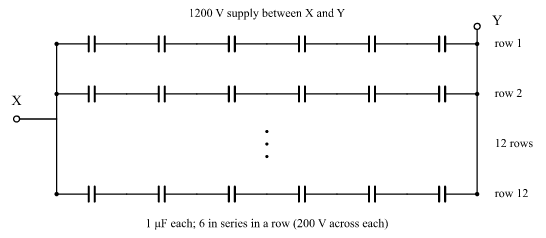 Result: minimum number capacitors, arranged as parallel rows, each row having capacitors in series.OR (b)(i)
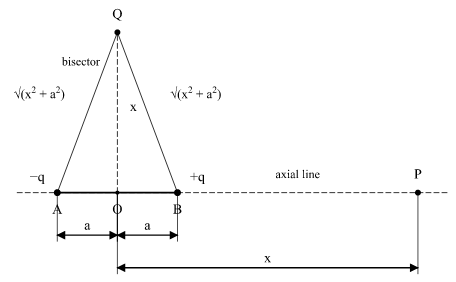 Let be at A and at B, with , centre O and ; .(I) Point P on the axis, (on the side of ): , For : (II) Point Q on the bisector, : The potential at every point of the bisector (equatorial) line is zero.(b)(ii)Using and : N m N mAngle of the torque with the x-axis: , measured from towards in the xy-plane.(Here , so the torque has its maximum value . The dipole itself makes with the x-axis, and the torque is perpendicular to it.)Result: N m, at about to the x-axis.
© examsnet.com
Go to Question: