Test Index
Electrostatic Potential and Capacitance
Electrostatic Potential and Capacitance

 CBSE Board Videos
© examsnet.com
Question : 10 of 28
Marks:
+1,
-0
A parallel plate capacitor consists of two conducting plates kept generally parallel to each other at a distance. When the capacitor is charged, the charge resides on the inner surfaces of the plates and an electric field is set up between them. Thus, electrostatic energy is stored in the capacitor. The figure shows three large square metallic plates, each of side '' held parallel and equidistant from each other. The space between and and and is completely filled with mica sheets of dielectric constant ''. The plate is connected to point A and other plates and are connected to point B. Point A is maintained at a positive potential with respect to point B and the potential difference between A and B is .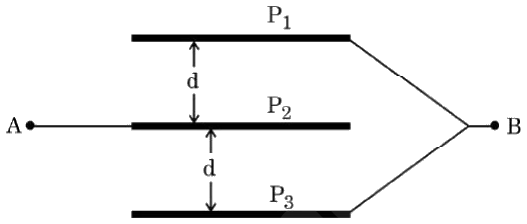 (i) The capacitance of the system between A and B will be :(A) (B) (C) (D) (ii) The charge on plate is :(A) (B) (C) (D) (iii) The electric field in the region between and is :(A) (B) (C) (D) (iv) (a) The separation between the plates of same area () of a parallel plate air capacitor having capacitance equal to that of this system, will be :(A) (B) (C) (D) OR(b) If the source of potential difference applied between A and B is removed, and then A and B are connected by a conducting wire, the net charge on the system will be :(A) (B) (C) (D) Zero
[CBSE 2025 55/4/3]
Solution:
Concept: is at potential of A; and are both at potential of B. So the system is two capacitors, and , each with the full voltage across it: they are in parallel.Each has area , separation and dielectric :(i)Answer: Option C(ii)Plate forms the capacitor with voltage across it: (negative, since is at the lower potential)Answer: Option B(iii)The potential difference between and is and their separation is , so the uniform field isAnswer: Option A(iv) (a)Air capacitor: Answer: Option COR (b)When charged, carries and , carry each, so the net charge of the whole system is . Joining A and B with a wire only lets the charges neutralise; no charge enters or leaves the system, so the net charge stays zero.Answer: Option D (Zero)
© examsnet.com
Go to Question: