Test Index
Electrostatic Potential and Capacitance
Electrostatic Potential and Capacitance

 CBSE Board Videos
© examsnet.com
Question : 11 of 28
Marks:
+1,
-0
A parallel plate capacitor has two parallel plates which are separated by an insulating medium like air, mica, etc. When the plates are connected to the terminals of a battery, they get equal and opposite charges and an electric field is set up in between them. This electric field between the two plates depends upon the potential difference applied, the separation of the plates and nature of the medium between the plates.(i) The electric field between the plates of a parallel plate capacitor is E. Now the separation between the plates is doubled and simultaneously the applied potential difference between the plates is reduced to half of its initial value. The new value of the electric field between the plates will be :(A) (B) (C) (D) (ii) A constant electric field is to be maintained between the two plates of a capacitor whose separation d changes with time. Which of the graphs correctly depict the potential difference () to be applied between the plates as a function of separation between the plates (d) to maintain the constant electric field ?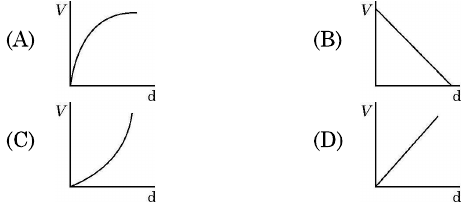 (iii)
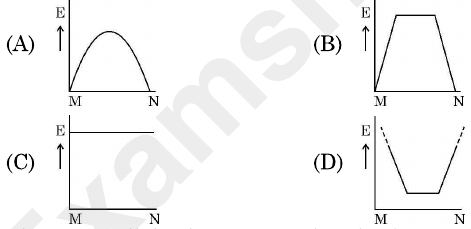
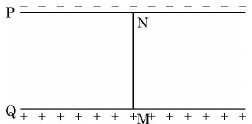 In the above figure P, Q are the two parallel plates of a capacitor. Plate Q is at positive potential with respect to plate P. MN is an imaginary line drawn perpendicular to the plates. Which of the graphs shows correctly the variations of the magnitude of electric field strength E along the line MN ?
 (iv) Three parallel plates are placed above each other with equal displacement between neighbouring plates. The electric field between the first pair of the plates is and the electric field between the second pair of the plates is . The potential difference between the third and the first plate is –(A) (B) (C) (D) ORA material of dielectric constant K is filled in a parallel plate capacitor of capacitance C. The new value of its capacitance becomes(A) (B) (C) (D)
[CBSE 2025 55/2/1]
Solution:
Concept:Between the plates of a parallel plate capacitor the field is uniform: , and .(i) Answer: (C) (ii) For a constant , . So must increase linearly with : a straight line through the origin.Answer: (D) (straight line through the origin)(iii) The field between the plates of a parallel plate capacitor is uniform, , the same at every point between the plates (ignoring edge effects). So along MN the magnitude of stays constant from M to N.Answer: (C) (horizontal straight line)(iv) Going from the first plate to the third, the potential drops by across the first gap and by across the second gap. So the potential difference between the third and the first plate isAnswer: (A) OR (iv) . Filling the gap completely with a dielectric of dielectric constant gives .Answer: (C)
© examsnet.com
Go to Question: