Test Index
Electrostatic Potential and Capacitance
Electrostatic Potential and Capacitance

 CBSE Board Videos
© examsnet.com
Question : 12 of 28
Marks:
+1,
-0
(a) (i) A small conducting sphere A of radius r charged to a potential V, is enclosed by a spherical conducting shell B of radius R. If A and B are connected by a thin wire, calculate the final potential on sphere A and shell B.(ii) Write two characteristics of equipotential surfaces. A uniform electric field of is set up in a region along axis. If the potential at the origin is V, find the potential at a point .OR(b) (i) What is difference between an open surface and a closed surface ? Draw elementary surface vector for a spherical surface S.(ii) Define electric flux through a surface. Give the significance of a Gaussian surface. A charge outside a Gaussian surface does not contribute to total electric flux through the surface. Why ?(iii) A small spherical shell has point charges , and inside it. This shell is enclosed by another big spherical shell . A point charge Q is placed in between the two surfaces and . If the electric flux through the surface is four times the flux through surface , find charge Q.
[CBSE 2025 55/2/1]
Solution:
(a)(i)Charge on sphere A (shell B initially uncharged): When A and B are joined by a wire they become one conductor. Charge on a conductor resides on its outer surface, so the whole charge flows to the outer shell B, and A and B are at the same potential.Potential of shell B: A is inside B and carries no charge now, so its potential equals that of B.Result: (a)(ii) Characteristics of equipotential surfaces (any two):1. The potential is the same at every point of the surface, so no work is done in moving a charge on it.2. The electric field is everywhere normal to the equipotential surface.3. Two equipotential surfaces never intersect.4. They are closer together where the field is stronger.Given: along , V (the field has no -component, so the -displacement changes nothing) V VResult: Potential at is V.OR (b)(i)An open surface has a boundary (an edge), e.g. a disc or a hemispherical bowl; it does not enclose any volume and has no inside or outside. A closed surface has no boundary and encloses a volume, dividing space into an inside and an outside, e.g. a sphere or a cube.For a closed surface the area element vector has magnitude equal to the small area and points along the outward normal: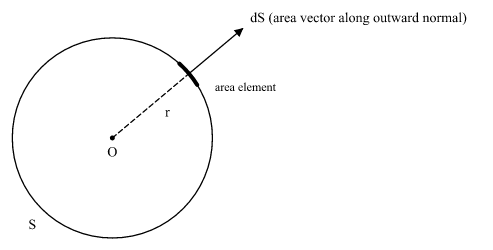 (b)(ii) Electric flux through a surface is the total number of electric field lines crossing it normally: (for a small area, ). SI unit: N m C.Significance of a Gaussian surface: it is an imaginary closed surface to which Gauss's law is applied. Chosen to match the symmetry of the charge distribution (so that is constant and normal, or parallel, over its parts), it lets us find easily.A charge outside the surface: every field line from it that enters the closed surface also leaves it. The inward (negative) flux equals the outward (positive) flux, so its net contribution to the total flux is zero.(b)(iii)Charge inside : Charge inside : , so (in C)Result:
© examsnet.com
Go to Question: