Test Index

Electric Charges and Fields Get it on Google PlayDownload on the App Store CBSE Board Videos

© examsnet.com
Question : 3 of 29
Marks: +1, -0
(a) An electric dipole consists of two point charges qq and −q-q separated by a distance 2a2a. Derive an expression for the electric field E⃗\vec{E} due to this dipole at a point distant rr from the centre of the dipole on the equatorial plane. Write the expression for the electric field at a far off point, i.e. r>>ar >> a.
(b) A dipole is placed in x-y plane such that charges qq and −q-q are located at x=ax = a and x=bx = b respectively. There exists an electric field E⃗=2i^ NC\vec{E} = 2\hat{i} \ \dfrac{\text{N}}{\text{C}} in the region. Calculate the force F⃗\vec{F} and torque τ⃗\vec{\tau} experienced by the dipole.
OR
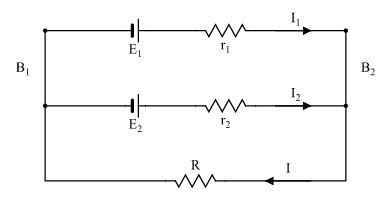
(a) Two cells of emf E1E_1 and E2E_2 with internal resistances r1r_1 and r2r_2 respectively, are connected in parallel by connecting their positive terminals together and negative terminals together. Deduce an expression for equivalent emf and equivalent internal resistance of the combination.
(b) A parallel combination, as stated in (a) above, of two cells of emfs EE and 3E3E and internal resistances RR each is connected across a resistance 2R2R. Find the current that flows through resistance 2R2R.
[CBSE 2026 55/1/3]
Solution:  
(a)
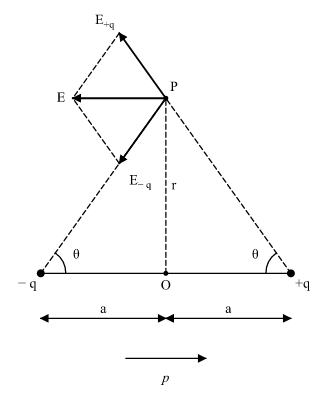
Let −q-q be at A and +q+q at B, with AB=2aAB = 2a and centre O. P is on the equatorial line with OP=rOP = r, so AP=BP=r2+a2AP = BP = \sqrt{r^2 + a^2}. Dipole moment p⃗=q(2a)p^\vec{p} = q(2a)\hat{p}, directed from −q-q to +q+q.
Fields at P (equal in magnitude):
E+q=E−q=14πε0qr2+a2E_{+q} = E_{-q} = \dfrac{1}{4\pi\varepsilon_0}\dfrac{q}{r^2 + a^2}
E⃗+q\vec{E}_{+q} is along BP (away from +q+q) and E⃗−q\vec{E}_{-q} is along PA (towards −q-q).
Resolve each along and perpendicular to the dipole axis. The components perpendicular to the axis are equal and opposite, so they cancel. The components parallel to the axis add, and point opposite to p⃗\vec{p}:
E=2E+qcos⁡θE = 2E_{+q}\cos\theta, where cos⁡θ=ar2+a2\cos\theta = \dfrac{a}{\sqrt{r^2 + a^2}}
E=2×14πε0qr2+a2×a(r2+a2)1/2=14πε02qa(r2+a2)3/2E = 2 \times \dfrac{1}{4\pi\varepsilon_0}\dfrac{q}{r^2 + a^2} \times \dfrac{a}{(r^2 + a^2)^{1/2}} = \dfrac{1}{4\pi\varepsilon_0}\dfrac{2qa}{(r^2 + a^2)^{3/2}}
In vector form, with p=2qap = 2qa:
E⃗=−14πε0p⃗(r2+a2)3/2\vec{E} = -\dfrac{1}{4\pi\varepsilon_0}\dfrac{\vec{p}}{(r^2 + a^2)^{3/2}}Far off point (r>>ar >> a, so r2+a2≈r2r^2 + a^2 \approx r^2):
E⃗=−14πε0p⃗r3\vec{E} = -\dfrac{1}{4\pi\varepsilon_0}\dfrac{\vec{p}}{r^3}
(b) Force on +q+q: F⃗1=qE⃗=2qi^\vec{F}_1 = q\vec{E} = 2q\hat{i}; force on −q-q: F⃗2=−qE⃗=−2qi^\vec{F}_2 = -q\vec{E} = -2q\hat{i}
Net force F⃗=F⃗1+F⃗2=0\vec{F} = \vec{F}_1 + \vec{F}_2 = 0 (a dipole in a uniform field feels no net force).
Dipole moment (from −q-q at x=bx = b to +q+q at x=ax = a): p⃗=q(a−b)i^\vec{p} = q(a - b)\hat{i}
Torque τ⃗=p⃗×E⃗=q(a−b)i^×2i^=0\vec{\tau} = \vec{p} \times \vec{E} = q(a - b)\hat{i} \times 2\hat{i} = 0, since i^×i^=0\hat{i} \times \hat{i} = 0.
Result: F⃗=0\vec{F} = 0 and τ⃗=0\vec{\tau} = 0. The dipole lies along the field (θ=0∘\theta = 0^\circ or 180∘180^\circ), so τ=pEsin⁡θ=0\tau = pE\sin\theta = 0.
OR (a)
The positive terminals are joined at B2B_2 and the negative terminals at B1B_1. Let VV be the potential difference between B2B_2 and B1B_1, and let the cells send currents I1I_1 and I2I_2, so the external current is I=I1+I2I = I_1 + I_2.
For each cell, terminal voltage = emf minus the drop on its internal resistance:
V=E1−I1r1⇒I1=E1−Vr1V = E_1 - I_1 r_1 \Rightarrow I_1 = \dfrac{E_1 - V}{r_1}
V=E2−I2r2⇒I2=E2−Vr2V = E_2 - I_2 r_2 \Rightarrow I_2 = \dfrac{E_2 - V}{r_2}
I=I1+I2=(E1r1+E2r2)−V(1r1+1r2)I = I_1 + I_2 = \left(\dfrac{E_1}{r_1} + \dfrac{E_2}{r_2}\right) - V\left(\dfrac{1}{r_1} + \dfrac{1}{r_2}\right)
V=E1r2+E2r1r1+r2−Ir1r2r1+r2V = \dfrac{E_1 r_2 + E_2 r_1}{r_1 + r_2} - I\dfrac{r_1 r_2}{r_1 + r_2}
Comparing with V=Eeq−IreqV = E_{eq} - I r_{eq} for a single equivalent cell:
Eeq=E1r2+E2r1r1+r2,req=r1r2r1+r2E_{eq} = \dfrac{E_1 r_2 + E_2 r_1}{r_1 + r_2}, \qquad r_{eq} = \dfrac{r_1 r_2}{r_1 + r_2}Equivalently, Eeqreq=E1r1+E2r2\dfrac{E_{eq}}{r_{eq}} = \dfrac{E_1}{r_1} + \dfrac{E_2}{r_2} and 1req=1r1+1r2\dfrac{1}{r_{eq}} = \dfrac{1}{r_1} + \dfrac{1}{r_2}.
OR (b)
Given: E1=EE_1 = E, E2=3EE_2 = 3E, r1=r2=Rr_1 = r_2 = R, external resistance 2R2R
Eeq=E⋅R+3E⋅RR+R=4ER2R=2EE_{eq} = \dfrac{E \cdot R + 3E \cdot R}{R + R} = \dfrac{4ER}{2R} = 2E
req=R×RR+R=R2r_{eq} = \dfrac{R \times R}{R + R} = \dfrac{R}{2}
I=Eeq2R+req=2E2R+R2=2E5R2=4E5RI = \dfrac{E_{eq}}{2R + r_{eq}} = \dfrac{2E}{2R + \frac{R}{2}} = \dfrac{2E}{\frac{5R}{2}} = \dfrac{4E}{5R}
Result: Current through 2R2R is 4E5R\dfrac{4E}{5R}.
© examsnet.com
Advertisements
Go to Question: