Test Index
Electric Charges and Fields
Electric Charges and Fields

 CBSE Board Videos
© examsnet.com
Question : 4 of 29
Marks:
+1,
-0
Two point charges and are located at points and respectively, in x-y plane. The electric field at the origin will be :
[CBSE 2026 55/5/2]
Solution:
Concept:The field of a point charge has magnitude , points away from a positive charge and towards a negative charge. Fields add as vectors.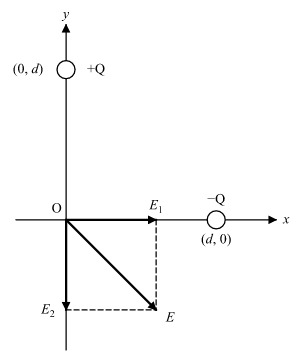 Solution:Both charges are at distance from O, so each field has magnitude . at : field at O points towards the charge, i.e. along : at : field at O points away from the charge, i.e. along : Key point: The magnitude is , but the vector already has length ; writing in front as well would double count it.Answer:Option C ()
© examsnet.com
Go to Question: