Test Index
Electric Charges and Fields
Electric Charges and Fields

 CBSE Board Videos
© examsnet.com
Question : 2 of 29
Marks:
+1,
-0
(a) Using Gauss's law, deduce an expression for electric field at a point due to a uniformly charged infinite plane thin sheet.(b) Two large thin plane sheets, each having surface charge density , are held close and parallel to each other in air. What is the net electric field at a point (i) inside and (ii) outside, the sheets?OR(a) Obtain the condition of balance of a Wheatstone bridge.(b) Find net resistance of the network of resistors connected between A and B, as shown in figure.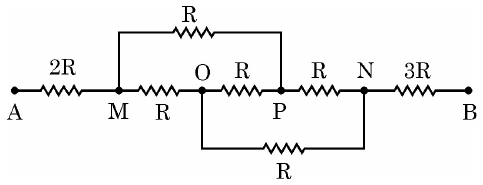
[CBSE 2026 55/1/3]
Solution:
(a)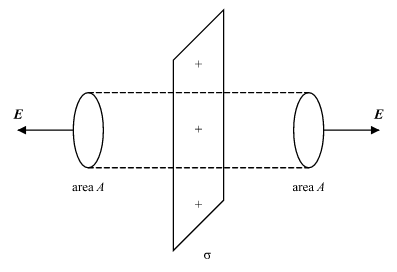 Let the sheet have uniform surface charge density . By symmetry the field is normal to the sheet, pointing away on both sides (for ), with the same magnitude at equal distances.Take as Gaussian surface a cylinder of cross-sectional area with its axis normal to the sheet, passing through it, its flat faces on either side.Flux through the curved surface ( is parallel to it).Flux through the two flat faces Charge enclosed Gauss's law: directed normally away from the sheet (towards it if is negative); it does not depend on the distance from the sheet.(b)
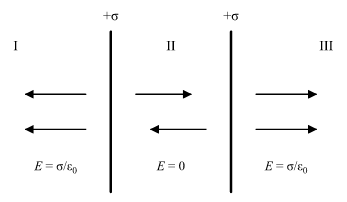 Each sheet produces directed away from itself.(i) Inside (between the sheets) the two fields are opposite: (ii) Outside the two fields are in the same direction: , directed away from the sheets.OR (a)
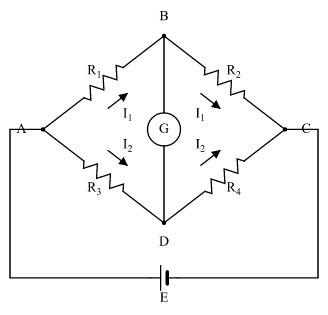 Four resistances (AB), (BC), (AD) and (DC) form the bridge; a cell is connected across A and C and a galvanometer G (resistance ) across B and D. Let be the galvanometer current.Kirchhoff's loop rule:Loop ABDA: ...(1)Loop BCDB: ...(2)At balance the galvanometer shows no deflection, (B and D are at the same potential):From (1): ...(3)From (2): ...(4)Dividing (3) by (4):This is the balance condition of the Wheatstone bridge.OR (b)Between M and N the resistors form a bridge: M-O (), O-N () on one side, M-P (), P-N () on the other, and O-P () as the bridge arm., so the bridge is balanced: no current flows in O-P and it can be removed.Result: net resistance between A and B
© examsnet.com
Go to Question: