Test Index
CBSE Class 12 Physics 2020 Delhi Set 1 Paper
© examsnet.com
Question : 36 of 37
Marks:
+1,
-0
(a) Show that an ideal conductor does not dissipate power in an a.c. circuit. (b) The variation of inductive reactance of an inductor with the frequency of the a.c. source of and variable frequency is shown in the figure.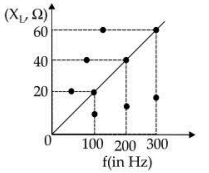 (i) Calculate the self-inductance of the inductor. (ii) When this inductor is used in series with a capacitor of unknown value and a resistor of at , maximum power dissipation occurs in the circuit. Calculate the capacitance of the capacitor. OR (a) A conductor of length ' ' is rotated about one of its ends at a constant angular speed ' ' in a plane perpendicular to a uniform magnetic field B. Plot graphs to show variations of the emf induced across the IP variations of the emf induced across the ends of the conductor with (i) angular speed and (ii) length of the conductor .(b) Two concentric circular loops of radii and are placed coaxially.(i) Find mutual inductance of the arrangement.(ii) If the current passed through the outer loop is changed at a rate of , find the emf induced in the inner loop. Assume the magnetic field on the inner loop to be uniform.
Solution:
(a) Power dissipation For ideal inductor Thus, ideal inductor does not dissipate power in an ac circuit. (b) (i) Inductive reactance (ii) Power dissipation is maximum when Or OR (a) (i) So, So, the graph is :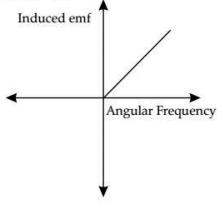 (ii) So, So, the graph is :
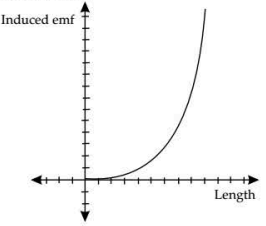 (b) (i) Putting the values (ii)
© examsnet.com
Go to Question: