Test Index
CBSE Class 12 Physics 2020 Delhi Set 1 Paper
© examsnet.com
Question : 37 of 37
Marks:
+1,
-0
(a) Write two important characteristics of equipotential surfaces. (b) A thin circular ring of radius is charged uniformly so its linear charge density becomes . Derive an expression for the electric field at a point at a distance from it along the axis of the ring. Hence, prove that for large distance , the ring behaves as a point charge. OR (a) State Gauss's law on electrostatics and derive an expression for the electric field due to a long, straight and thin uniformly charged wire (linear charge density ) at a point lying at a distance from the wire. (b) The magnitude of electric field (in ) in a region varies with the distance (in ) as By how much, does the electric potential increase in moving from point at to a point at .
Solution:
(a) Characteristics of equipotential surface : (i) Potential remains the same at all the points on equipotential surface. (ii) No work is required to move a charge within an equipotential surface. (b) Point is on theaxis of the ring at a distance from the centre. The field due to a small element is considered. Linear charge density So, charge of element is 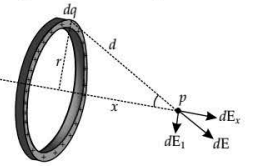 The perpendicular field component for the whole ring will be zero. So, Or, Or, When This reduces to a simple Coulomb field. In this case, the charged ring looks like a point charge. OR (a) Gauss's Law: The total of the electric flux out of a closed surface is equal to the chargeenclosed divided by the permittivity.Electric field due to an infinitely long straight uniformly charged wire : charge density is a point where the electric field is to be calculated. distance of point from the wire electric field at the point
 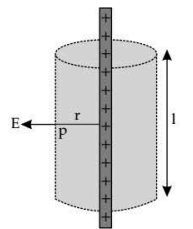 A cylinder of length 1 , radius , closed at each end is imagined as Gaussian surface. very small area on the Gaussian surface By symmetry, the magnitude of the electric field will be the same at all points on the curved surface of the cylinder and directed radially outward. and ds are along the same direction.Theelectric flux through curved surface the net charge enclosed by Gaussian surface is (b) Thus, electric potential changes by .
© examsnet.com
Go to Question: