Test Index
CBSE Class 12 Physics 2020 Delhi Set 1 Paper
© examsnet.com
Question : 35 of 37
Marks:
+1,
-0
SECTION - D
(a) Define the term 'focal length of a mirror' with the help of any diagram. Obtain the relation between focal length and radius of curvature. (b) Calculate the angle of emergence (e) of the ray of light incident normally on the face AC of a glass prism of refractive index . How will the angle of emergence change qualitatively, if the ray of light emerges from the prism into a liquid of refractive index 1.3 instead of air? 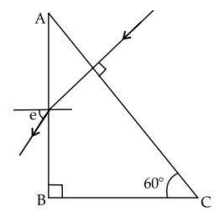
Solution:
(a) Focal length of mirror : When rays of light parallel to the principal axis of a mirror is incident on it, the rays after reflection, either converge at a point or appear to diverge from a point. The distance of that point from the pole of the mirror is known as the focal length of the mirror. Relation between focal length and radius of curvature: A ray of light travelling parallel to the principal axis PC is incident on a spherical mirror PP'. It reflects along . For concave mirror, it passes through the focus . For convex mirror, extending the ray backward it appears to pass through the focus. is the pole and is the focus of the mirror. is the centre of curvature. is the normal to the mirror at the point of incidence . For concave mirror, 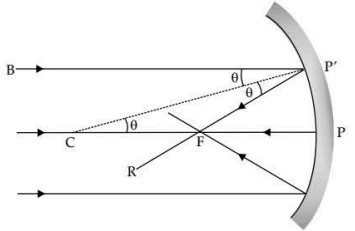 and (law of reflection, ) Hence is isosceles. Hence, If the aperture of the mirror is small, the point is very close to the point , then (b) Angle of incidence at the face Now, the prism is immersed in a liquid of refractive index 1.3. The refractive index of the surrounding medium is now greater than that of air but less than that of the medium of prism. Now, the angle of emergence be less than OR (a) Resolving power is the ability of the telescope to distinguish clearly between two points whose angular separation is less than the smallest angle that the observer's eye can resolve. Resolving power of a telescope where, diameter of the objective and wavelength. (i) When wavelength of the light increases, the resolving power of the telescope decreases. (ii) When diameter of the objective increases, the resolving power of the telescope increase. (b)
 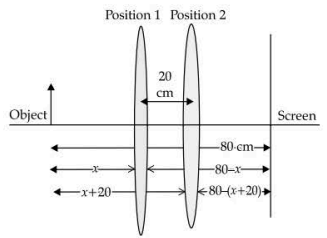 For position 1: .......(i) For position 2: ........(ii) Comparing equations (i) and (ii) Putting the value of in equation (i)
© examsnet.com
Go to Question: