Test Index
Aldehydes, Ketones and Carboxylic Acids
Aldehydes, Ketones and Carboxylic Acids

 CBSE Board Videos
© examsnet.com
Question : 7 of 45
Marks:
+1,
-0
What happens when :(a) Propanenitrile is treated with phenyl magnesium bromide followed by hydrolysis ?(b) p-fluorotoluene is treated with in the presence of acetic anhydride followed by hydrolysis with aqueous acid.(c) Phthalic acid is treated with followed by heating ?Write chemical reactions in support of your answer.
[CBSE 2026 56/4/2]
Solution:
(a) The Grignard reagent adds to the group to give an imine salt, which on acid hydrolysis gives a ketone, propiophenone (1-phenylpropan-1-one).(b) Chromic oxide () in acetic anhydride converts the methyl group into a benzylidene diacetate, which is hydrolysed by aqueous acid to the aldehyde: p-fluorobenzaldehyde is formed.(c) Phthalic acid first forms ammonium phthalate; on heating this loses water to give phthalamide, and on strong heating phthalamide loses ammonia to give phthalimide. (phthalimide)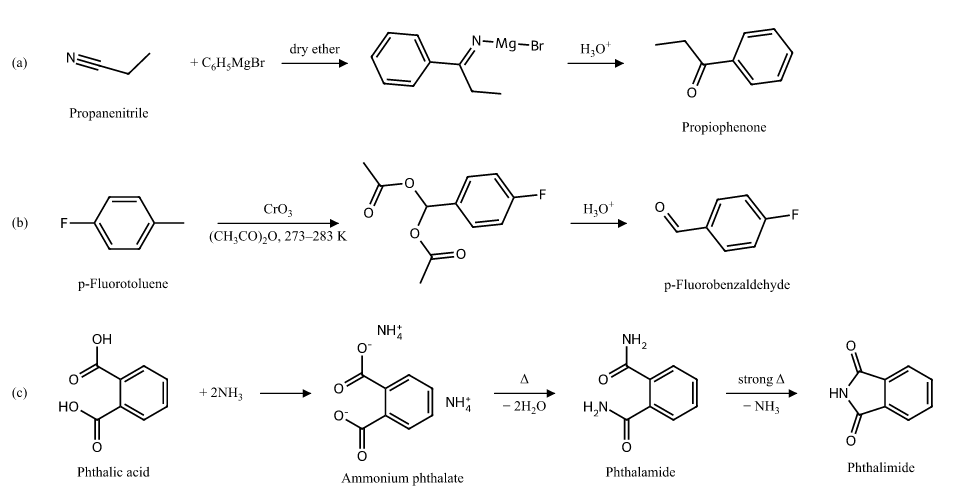
© examsnet.com
Go to Question: