Test Index
Aldehydes, Ketones and Carboxylic Acids
Aldehydes, Ketones and Carboxylic Acids

 CBSE Board Videos
© examsnet.com
Question : 8 of 45
Marks:
+1,
-0
(a) (i) How will you bring about the following conversions :(I) Bromobenzene to 1-phenylethanol(II) Benzene to m-nitroacetophenone(ii) An organic compound with the molecular formula forms 2,4-DNP derivative, reduces Tollens' reagent and undergoes Cannizzaro reaction. On vigorous oxidation with acidic or alkaline it gives Benzene-1,2-dicarboxylic acid. Identify the compound and write the products when it undergoes Cannizzaro reaction.(iii) Arrange the following compounds in increasing order of their acid strength :, , , OR(b) (i) Write the products formed when benzaldehyde reacts with the following reagents :(I) 2,4-Dinitrophenylhydrazine(II) Acetophenone in the presence of dilute NaOH followed by heating(ii) Give reasons for the following :(I) Benzoic acid does not undergo Friedel-Crafts reaction.(II) Carboxylic acids have higher boiling point than alcohols of comparable molecular mass.(iii) Write simple chemical test to distinguish between propanal and propanone.
[CBSE 2026 56/4/2]
Solution:
(a)(i)(I) Bromobenzene is converted into the Grignard reagent, which adds to ethanal; hydrolysis of the adduct gives the secondary alcohol:(a)(i)(II) Friedel–Crafts acylation first gives acetophenone; its – group is meta-directing, so nitration then gives the meta product. (The order matters: nitrobenzene does not undergo Friedel–Crafts acylation.)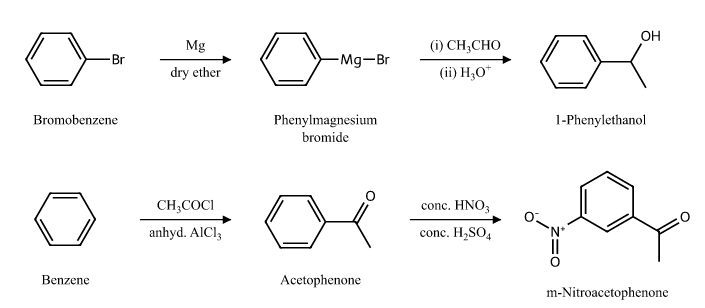 (a)(ii) Reasoning from the data:• Forms a 2,4-DNP derivative: a carbonyl compound.• Reduces Tollens' reagent: an aldehyde.• Undergoes Cannizzaro reaction: no -hydrogen, so the –CHO group is attached directly to the ring.• Vigorous oxidation gives benzene-1,2-dicarboxylic acid (phthalic acid): the ring has two side chains in ortho positions. Besides –CHO, the remaining carbon is a – group ().So the compound is 2-methylbenzaldehyde (o-tolualdehyde).Cannizzaro reaction (conc. NaOH): one molecule is reduced to the alcohol and the other oxidised to the acid salt:
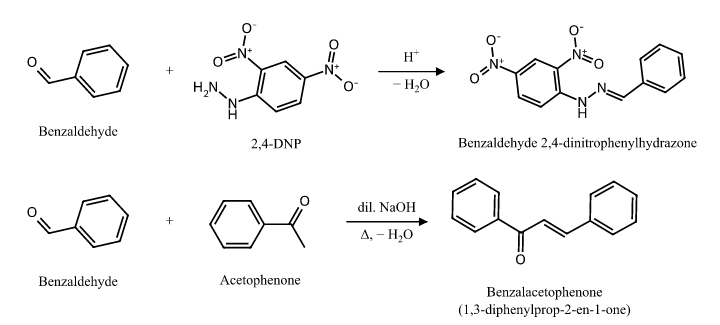
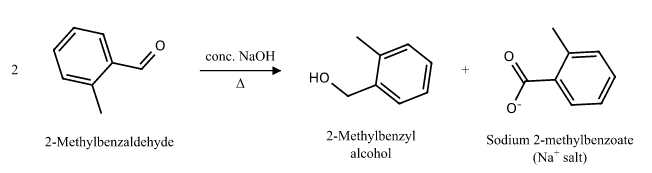 Products: 2-methylbenzyl alcohol and sodium 2-methylbenzoate.(a)(iii) Electron-withdrawing groups stabilise the carboxylate ion and increase acid strength; the phenyl group (electron-releasing by resonance to the –COOH group) makes benzoic acid weaker than formic acid. Three strongly electron-withdrawing F atoms make stronger than nitroacetic acid.Increasing acid strength:(: , , , )OR (b)(i)(I) Benzaldehyde condenses with 2,4-dinitrophenylhydrazine (loss of water) to give benzaldehyde 2,4-dinitrophenylhydrazone (an orange-yellow solid):(II) Cross aldol (Claisen–Schmidt) condensation: acetophenone forms an enolate with dilute NaOH, which adds to benzaldehyde; on heating the aldol loses water to give benzalacetophenone (chalcone):
 (b)(ii)(I) The –COOH group is strongly electron-withdrawing and deactivates the benzene ring. Also, the Lewis-acid catalyst anhydrous gets bonded to the carboxyl group (forms a salt/complex), so the catalyst is used up. Hence benzoic acid does not undergo Friedel–Crafts reactions.(b)(ii)(II) Carboxylic acid molecules are held by more extensive intermolecular hydrogen bonding than alcohols: both the C=O oxygen and the –OH group take part, and two molecules form a hydrogen-bonded cyclic dimer that persists even in the vapour phase. More energy is needed to separate them, so their boiling points are higher.(b)(iii) Tollens' test: warm each compound with Tollens' reagent (ammoniacal silver nitrate). Propanal, an aldehyde, gives a silver mirror; propanone, a ketone, does not.(Alternatively, iodoform test: propanone, a methyl ketone, gives a yellow precipitate of with /NaOH; propanal does not.)
© examsnet.com
Go to Question: