Test Index
Aldehydes, Ketones and Carboxylic Acids
Aldehydes, Ketones and Carboxylic Acids

 CBSE Board Videos
© examsnet.com
Question : 6 of 45
Marks:
+1,
-0
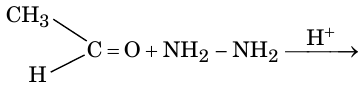
(a) (i) Arrange the following compounds in increasing order of their acidic strengths : (ii) Why is more reactive than acetone towards reaction with HCN ?(iii) Complete the equation :
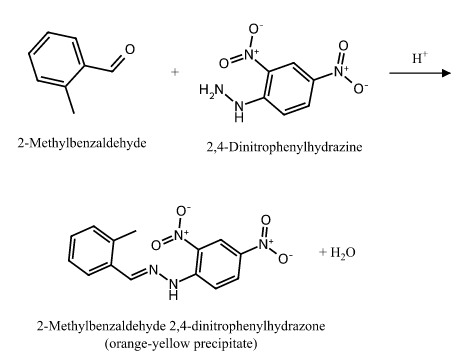
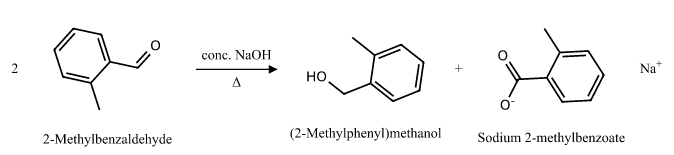
 OR(b) An organic compound with the molecular formula forms 2,4-DNP derivative, reduces Tollens' reagent and undergoes Cannizzaro reaction. On vigorous oxidation it gives Benzene-1,2-dicarboxylic acid. Identify the compound and write the reactions of compound 2,4-DNP and when it undergoes Cannizzaro reaction.
[CBSE 2026 56/5/3]
Solution:
(a)(i)An electron-withdrawing stabilises the carboxylate ion and increases acidity; its effect (−I) falls with distance. An electron-donating alkyl group (+I) decreases acidity.(2-methylpropanoic acid < 3-bromobutanoic acid < 2-bromobutanoic acid)(a)(ii)Addition of HCN is a nucleophilic addition. In acetone two methyl groups (i) push electrons to the carbonyl carbon (+I), making it less electrophilic, and (ii) crowd it, hindering the approach of . Ethanal has only one methyl group, so its carbonyl carbon is more electrophilic and less hindered; it reacts faster.(a)(iii)Ethanal condenses with hydrazine (addition then loss of water) to give ethanal hydrazone:OR (b)Deductions:• Forms a 2,4-DNP derivative: a carbonyl compound.• Reduces Tollens' reagent: an aldehyde.• Undergoes Cannizzaro reaction: no -hydrogen (the CHO is on the ring).• Vigorous oxidation gives benzene-1,2-dicarboxylic (phthalic) acid: a benzene ring with two adjacent (1,2) side chains. with ortho groups, so the compound is 2-methylbenzaldehyde (o-tolualdehyde).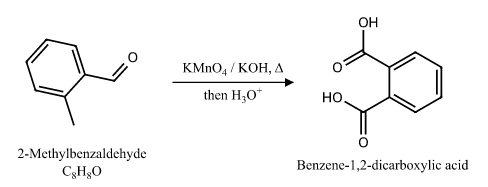 Reaction with 2,4-DNP:
 Cannizzaro reaction (conc. NaOH; one molecule is oxidised, the other reduced):
© examsnet.com
Go to Question: