Test Index
CBSE Class 12 Biology 2026 Paper 57/2/3
CBSE Class 12 Biology 2026 Paper 57/2/3


© examsnet.com
Question : 32 of 33
Marks:
+1,
-0
(a) A 30 year old man was admitted to a hospital with recurrent infections, weight loss, prolonged fever. His blood report showed a decline in count of T-Lymphocytes thus affecting immune system.(i) Identify the disease and its causative agent. 2(ii) How did the pathogen affect the immune system once it entered the body ? Explain. 2(iii) Mention two major modes of its transmission. 1OR(b) (i) Why are microbes considered effective biocontrol agents in sustainable agriculture ? 1(ii) Explain the role of the following as biocontrol agents naming the pests or diseases they help to control :(1) A Bacterium 1½(2) A Fungus 1(3) Virus 1½
Solution:
(a)(i)Disease: AIDS (Acquired Immuno Deficiency Syndrome).Causative agent: HIV (Human Immunodeficiency Virus), a retrovirus with an RNA genome.(a)(ii)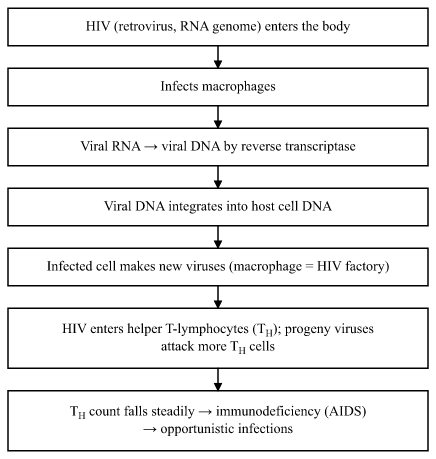 1. After entering the body, HIV first enters the macrophages.2. Its RNA genome is copied into viral DNA by the enzyme reverse transcriptase.3. The viral DNA is incorporated into the host cell's DNA and directs the infected cell to produce virus particles; the macrophage keeps making viruses and acts like an HIV factory.4. At the same time HIV enters helper T-lymphocytes (), replicates and produces progeny viruses, which attack other helper T-cells. The number of helper T-lymphocytes falls steadily, so the immune system weakens and the person suffers from infections (bacteria, viruses, fungi, parasites such as Toxoplasma) that a normal body could fight.(a)(iii)Any two:1. Sexual contact with an infected person.2. Transfusion of contaminated blood and blood products.3. Sharing infected needles (intravenous drug abusers).4. From an infected mother to her child through the placenta.OR (b)(i)Biocontrol by microbes reduces our dependence on toxic chemicals and pesticides, which harm humans, animals and the environment. Microbial agents are often species-specific: they act on the target pest and do not harm plants, mammals, birds, fish or non-target (useful) insects. Pests are kept at manageable levels through natural checks and balances rather than wiped out, so the ecosystem stays healthy.(b)(ii)(1) BacteriumBacillus thuringiensis (Bt) controls butterfly and moth caterpillars (lepidopteran pests). Its dried spores are mixed with water and sprayed on plants (e.g. Brassica, fruit trees). The larvae eat them; in the alkaline gut of the larva the toxin is released and kills the caterpillar, while other insects are unharmed. Bt toxin genes are also put into crops (Bt cotton).(b)(ii)(2) FungusTrichoderma species are free-living fungi very common in root ecosystems. They are effective biocontrol agents of several plant pathogens (fungal diseases of plants).(b)(ii)(3) VirusBaculoviruses (mostly of the genus Nucleopolyhedrovirus) attack insects and other arthropods. They are species-specific, narrow-spectrum insecticides with no negative impact on plants, mammals, birds, fish or non-target insects, so they are very useful in integrated pest management (IPM), especially in ecologically sensitive areas.
© examsnet.com
Go to Question: