Test Index
CBSE Class 12 Biology 2026 Paper 57/2/3
CBSE Class 12 Biology 2026 Paper 57/2/3


© examsnet.com
Question : 33 of 33
Marks:
+1,
-0
(a) Observe the segment of mRNA given below and answers the questions given below :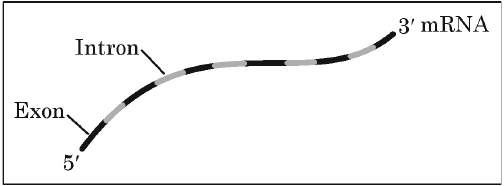 (i) Explain and illustrate the steps involved to make fully processed hn RNA. 3(ii) Gene encoding RNA polymerase I and RNA polymerase III have been affected by mutation.Explain its impact on the synthesis of polypeptide giving reasons. 2OR(b) In a particular cattle, the coat colour red and white are controlled by single pair of alleles. A calf that receives allele for red coat from mother and allele for white coat from father shows equal number of red and white hairs on its coat.(i) Is this an example of Co-dominance or incomplete dominance. Give a reason for your answer. 1(ii) With the help of a genetic cross upto generation, explain what will be the consequent phenotype of calf when(1) Red is dominant over white, 2(2) Red is incompletely dominant. 2
Solution:
(a)(i)In eukaryotes the primary transcript, hnRNA (heterogeneous nuclear RNA), has both coding sequences (exons) and non-coding sequences (introns), as in the figure. It is processed in the nucleus in three steps:1. Capping: an unusual nucleotide, methyl guanosine triphosphate (), is added to the 5′ end of hnRNA.2. Tailing: adenylate residues (about 200–300) are added at the 3′ end in a template-independent manner (poly-A tail).3. Splicing: the introns are removed and the exons are joined together in a defined order.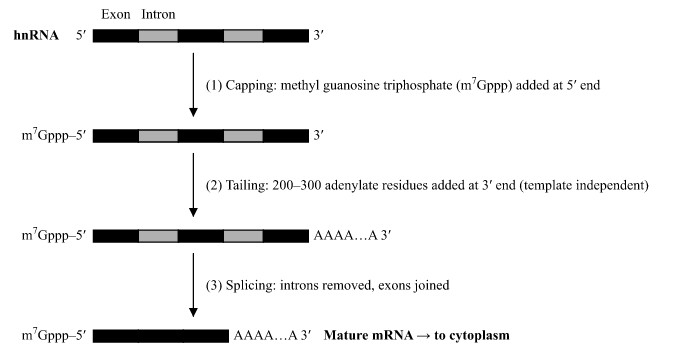 The fully processed hnRNA is now the mature mRNA; it is transported out of the nucleus to the cytoplasm for translation.(a)(ii)No polypeptide will be synthesised, even though mRNA can still be made by RNA polymerase II:1. RNA polymerase I transcribes rRNAs (28S, 18S and 5.8S). Without them ribosomes cannot be formed; rRNA plays a structural and catalytic role in translation (23S/28S rRNA acts as the ribozyme that forms peptide bonds).2. RNA polymerase III transcribes tRNA, 5S rRNA and snRNAs. Without tRNA, the adaptor molecule that reads the codons and brings amino acids to the ribosome is missing; without snRNAs, splicing of hnRNA also fails.Hence translation cannot take place and the polypeptide is not formed.OR (b)(i)It is co-dominance. The heterozygous calf shows both parental characters fully and equally (equal numbers of red and white hairs), not a blend. In incomplete dominance the would show an intermediate colour in every hair.(b)(ii)(1) Red dominant over whiteLet red = R, white = r.P: RR (red) rr (white)Gametes: R and r: Rr, all red coat (red masks white).: Rr Rr
genotypic ratio 1 RR : 2 Rr : 1 rr; phenotypic ratio 3 red : 1 white.So the calf (Rr) would have a fully red coat.(b)(ii)(2) Red incompletely dominantP: RR (red) rr (white)Gametes: R and r: Rr, all intermediate coat colour (pinkish / light red), a blend of the two.: Rr Rr
phenotypic ratio = genotypic ratio = 1 red : 2 intermediate : 1 white.So the calf (Rr) would have an intermediate (pinkish) coat.Key point: In dominance the phenotypic ratio is 3 : 1; in both incomplete dominance and co-dominance it is 1 : 2 : 1, because the heterozygote looks different from both parents.
| R | r | |
| R | RRRed | RrRed |
| r | RrRed | rrWhite |
| R | r | |
| R | RRRed | RrIntermediate |
| r | RrIntermediate | rrWhite |
© examsnet.com
Go to Question: