Test Index
CBSE Class 12 Biology 2026 Paper 57/2/3
CBSE Class 12 Biology 2026 Paper 57/2/3


© examsnet.com
Question : 31 of 33
Marks:
+1,
-0
(a) In the given diagram – ‘A’ is an embryonic stage that gets transformed into ‘B’, which in turn gets implanted in the endometrium of human female.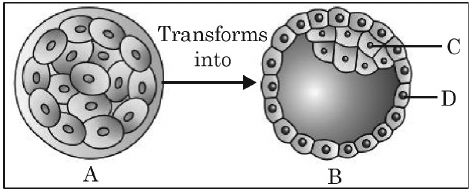 (i) (1) Identify A, B, C and D. 2(2) State the fate of ‘C’ immediately after implantation. 1(3) Name the special cells found in ‘C’ and their function. 1(ii) What is the role of oxytocin during parturition ? Where is it released from ? 1OR(b) Sexually transmitted infections are a major threat to our society. So it is said that “Prevention is better than cure”.(i) Write the three simple principles to be followed to prevent such infections. 3(ii) How can sex education programs in schools help in improving reproductive health ? (4 points) 2
Solution:
(a)(i)(1)A – Morula (8–16 celled embryo)B – BlastocystC – Inner cell massD – Trophoblast (outer layer of the blastocyst, which gets attached to the endometrium)(a)(i)(2)Immediately after implantation, the inner cell mass differentiates into the three germ layers: an outer ectoderm, a middle mesoderm and an inner endoderm. From these layers all the tissues and organs of the embryo are formed. (The trophoblast forms the chorionic villi, which with the uterine tissue form the placenta.)(a)(i)(3)The inner cell mass contains stem cells. They have the potency to give rise to all the tissues and organs of the body.(a)(ii)Oxytocin acts on the uterine muscles and causes vigorous uterine contractions, which expel the baby (parturition). The contractions stimulate further oxytocin secretion (foetal ejection reflex), so the contractions become stronger. It is released from the posterior pituitary of the mother.OR (b)(i)The three simple principles to prevent STIs:1. Avoid sex with unknown partners or multiple partners.2. Always use condoms during coitus.3. In case of doubt, go to a qualified doctor for early detection and get complete treatment if diagnosed with an infection.(b)(ii)Sex education in schools helps reproductive health by:1. Giving correct information about the reproductive organs, adolescence and related changes.2. Removing myths and misconceptions about sex-related aspects.3. Teaching safe and hygienic sexual practices.4. Giving correct information about STIs (including AIDS), their prevention, and birth control methods, so that adolescents lead a reproductively healthy life and avoid risky behaviour.
© examsnet.com
Go to Question: