Test Index
CBSE Class 12 Biology 2026 Paper 57/2/3
CBSE Class 12 Biology 2026 Paper 57/2/3


© examsnet.com
Question : 30 of 33
Marks:
+1,
-0
Below is shown a pond that represents a self-sustaining natural ecosystem with both biotic and abiotic components interacting in a balanced food web.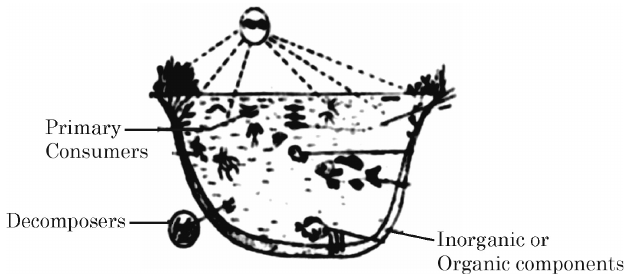 Based on the diagram, answer the questions :(a) Mention two abiotic components of a pond ecosystem. 1(b) Differentiate between the roles of producers and decomposers in such an ecosystem. 2(c) Draw a simple food chain operating in such an ecosystem and label each trophic level. 1OR(c) Why is transfer of energy not 100% efficient between trophic levels ? 1
Solution:
(a)Abiotic components of a pond (any two): water, dissolved inorganic substances (e.g. , , nitrates, phosphates), soil deposit at the bottom of the pond, sunlight (light), temperature, pH.(b)
(c)A grazing food chain of the pond:Phytoplankton Zooplankton Small fish Large fish Producer (1st trophic level) Primary consumer (2nd) Secondary consumer (3rd) Tertiary consumer (4th).OR (c)At every trophic level, most of the energy taken in is used in respiration and lost as heat, and some is lost in undigested and dead matter that passes to decomposers. Only about 10% of the energy is transferred to the next trophic level (10 per cent law). Hence energy transfer is never 100% efficient, and energy flow is unidirectional.
| Producers | Decomposers |
| Autotrophs: phytoplankton, algae, floating, submerged and marginal plants. | Heterotrophs: fungi, bacteria and flagellates, abundant at the bottom of the pond. |
| Fix solar energy by photosynthesis; convert inorganic substances (, water, minerals) into organic matter (food). | Break down dead organic matter (detritus) into simpler inorganic substances by decomposition. |
| Provide food and energy to all consumers; they form the first trophic level. | Release the minerals back to the pond for reuse by producers (nutrient cycling). |
© examsnet.com
Go to Question: