Test Index
CBSE Class 12 Biology 2025 Paper 57/7/2
CBSE Class 12 Biology 2025 Paper 57/7/2


© examsnet.com
Question : 30 of 33
Marks:
+1,
-0
Study the figure given below and answer the questions that follow.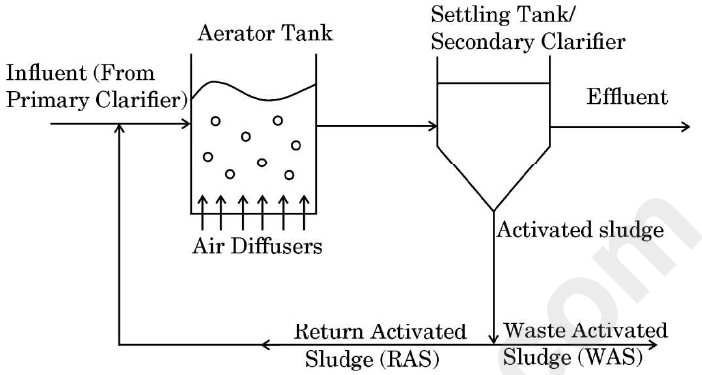 (a) Identify the figure and state its importance. (1)(b) Why is air diffused into the aerator tank? Explain. (2)(c) (i) What changes take place in the settling tank? (1)OR(c) (ii) How is BOD related to organic matter present in the water? (1)
Solution:
(a) The figure shows the secondary (biological) treatment stage of a sewage treatment plant (activated sludge process).Importance: microbes remove most of the organic matter from the primary effluent, so the BOD falls and the treated water can be released safely into rivers and streams without polluting them.(b) Air is pumped into the aeration tank and the effluent is agitated so that it gets plenty of oxygen.1. This allows vigorous growth of useful aerobic microbes into flocs (masses of bacteria associated with fungal filaments forming mesh-like structures).2. While growing, these aerobic microbes use oxygen to consume (oxidise) the major part of the organic matter in the effluent. This significantly reduces the BOD of the effluent.(c)(i) In the settling tank the bacterial flocs settle down; this sediment is called activated sludge. The clear effluent above it is released. A small part of the activated sludge is pumped back into the aeration tank as inoculum (return activated sludge, RAS); the major part (waste activated sludge, WAS) is pumped into large anaerobic sludge digesters, where anaerobic bacteria digest it and produce biogas (methane, hydrogen sulphide, carbon dioxide).OR (c)(ii) BOD (biochemical oxygen demand) is the amount of oxygen that would be consumed if all the organic matter in one litre of water were oxidised by bacteria. So BOD is a measure of the organic matter in the water: the more organic matter, the higher the BOD and the greater the polluting potential of the water.
© examsnet.com
Go to Question: