Test Index
CBSE Class 12 Biology 2025 Paper 57/7/2
CBSE Class 12 Biology 2025 Paper 57/7/2


© examsnet.com
Question : 29 of 33
Marks:
+1,
-0
The following question is based on pollination. Study the figures carefully and answer the questions that follow.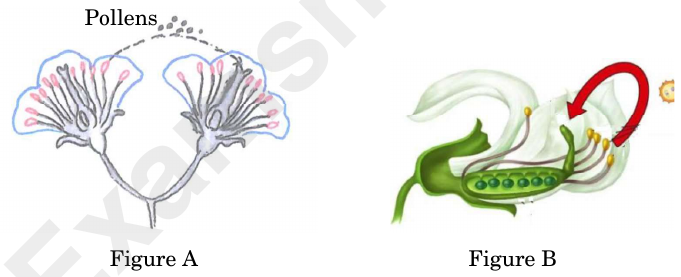 (a) Give the scientific terms for the processes taking place in Figures A and B respectively. (1)(b) Mention two conditions necessary for the process occurring in Figure B. (2)(c) (i) State one advantage and one disadvantage of the process occurring in Figure B. (1)OR(c) (ii) Name one plant where, in some flowers only, the process in Figure B takes place and give the reason responsible for it. (1)
Solution:
(a)Figure A: pollen from the anther of one flower reaches the stigma of another flower of the same plant ⇒ Geitonogamy.Figure B: pollen from the anther reaches the stigma of the same flower ⇒ Autogamy (self-pollination within a flower).(b) Conditions needed for autogamy (any two):1. The flower must be bisexual, with the anthers and the stigma lying close to each other.2. Synchrony: pollen release and stigma receptivity must happen at the same time.3. Best assured in closed (cleistogamous) flowers, where no other pollen can enter.(c)(i)Advantage: seed set is assured even when no pollinator is present (no dependence on pollinators); pure lines are maintained.Disadvantage: no genetic variation is produced; continued selfing leads to inbreeding depression.OR (c)(ii)Plant: Viola (common pansy) (also Oxalis, Commelina).Reason: these plants bear two kinds of flowers. Chasmogamous flowers open and expose their anthers and stigma, but cleistogamous flowers never open. In a cleistogamous flower the anthers and stigma lie close together inside the closed flower, so when the anthers dehisce, pollen falls on the stigma of the same flower and only autogamy is possible.
© examsnet.com
Go to Question: