Test Index
CBSE Class 12 Biology 2025 Paper 57/7/2
CBSE Class 12 Biology 2025 Paper 57/7/2


© examsnet.com
Question : 31 of 33
Marks:
+1,
-0
(a) (i) What is a test cross? How can we find out the zygosity of a plant by the use of test cross?(ii) Why are human females rarely haemophilic? Explain with the help of a cross. Under what conditions can a haemophilic female be born? How do haemophilic patients suffer?OR(b) Name the two events 'a' and 'c' shown in the diagram below.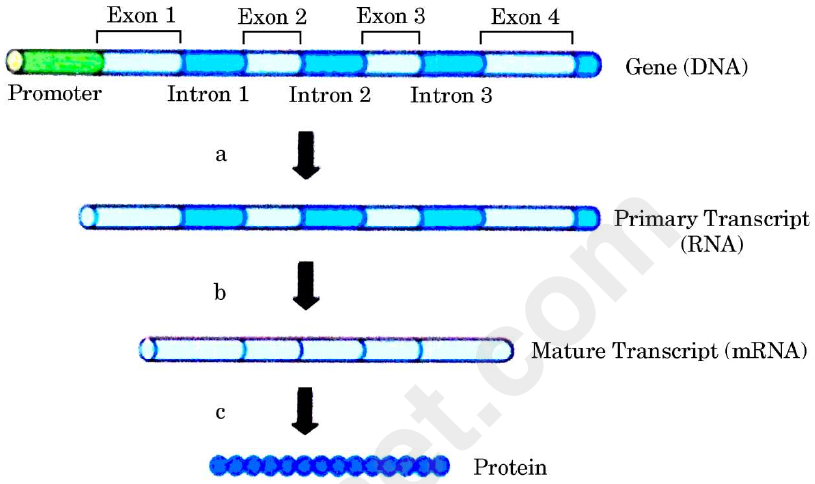 (i) Mention where in the cell these events take place.(ii) Explain the changes taking place during event 'b' and mention why these are needed.
Solution:
(a)(i)Test cross: a cross of an organism showing the dominant phenotype (whose genotype is not known) with a homozygous recessive parent. The recessive parent gives only recessive gametes, so the offspring show directly which gametes the unknown plant makes.Example: a violet-flowered pea plant ( or ) is crossed with a white-flowered plant ().Case 1: unknown plant is ⇒ all progeny violet.
Case 2: unknown plant is ⇒ violet : white .
Result: All offspring with the dominant phenotype ⇒ the plant is homozygous (). Dominant and recessive offspring in a ratio ⇒ the plant is heterozygous ().(a)(ii)Haemophilia is a sex-linked recessive disease: its gene () lies on the X chromosome. A male () with one is haemophilic, but a female needs both X chromosomes carrying the gene (). A heterozygous female () is only a carrier and is normal.Cross: carrier mother normal father ()
Daughters are normal or carriers; half the sons are haemophilic. No daughter is haemophilic.When can a haemophilic female be born? Only when the mother is at least a carrier () and the father is haemophilic (), so that the daughter receives from both parents:
Such a combination is very rare (the gene is rare and haemophilic males often do not survive to reproduce), so human females are rarely haemophilic.How patients suffer: a single protein that is part of the cascade of proteins involved in blood clotting is affected, so blood does not clot. Even a simple cut results in non-stop bleeding.OR (b)Event 'a': Transcription (DNA → primary transcript, hnRNA).Event 'c': Translation (mRNA → protein).(b)(i) In a eukaryotic cell, transcription ('a') takes place in the nucleus; translation ('c') takes place in the cytoplasm, on ribosomes.(b)(ii) Event 'b' is RNA processing of the primary transcript (hnRNA) in the nucleus:1. Splicing: the introns (non-coding sequences) are removed and the exons (coding sequences) are joined together in a defined order.2. Capping: an unusual nucleotide, methyl guanosine triphosphate, is added to the 5' end of the hnRNA.3. Tailing: adenylate residues (200-300) are added at the 3' end in a template-independent manner (poly-A tail).Why needed: the primary transcript contains introns, which do not code for the protein; they must be removed so that only the coding sequence is translated into the correct protein. Capping and tailing convert the hnRNA into a functional mRNA that is transported out of the nucleus and translated in the cytoplasm.
| Gametes | ||
| (violet) | (violet) | |
| (violet) | (violet) |
| Gametes | ||
| (violet) | (white) | |
| (violet) | (white) |
| Gametes | (father) | (father) |
| (mother) | normal female | normal male |
| (mother) | carrier female | haemophilic male |
| Gametes | (father) | (father) |
| (mother) | carrier female | normal male |
| (mother) | haemophilic female | haemophilic male |
© examsnet.com
Go to Question: