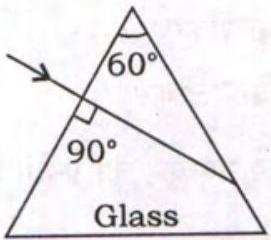
Concept:Total Internal Reflection (TIR) and geometry of light refraction through a prism.
Explanation:1. The light ray falls normally (
90∘) on the first face of the equilateral prism (all angles are
60∘), so it passes through undeviated.
2. It strikes the second face. Using the geometry of the triangle formed at the top (angles
90∘,
60∘, and
30∘), the angle between the ray and the second face is
30∘. Thus, the angle of incidence is
90∘−30∘=60∘.
3. The critical angle for glass is approximately
42∘. Since the angle of incidence (
60∘) is greater than the critical angle, Total Internal Reflection (TIR) takes place.
4. The ray reflects at an angle of
60∘, which means it makes an angle of
30∘ with the second face.
5. The reflected ray travels towards the base. In the new triangle formed with the base, the angles are
60∘ (prism base angle) and
30∘. The third angle where the ray hits the base is
180∘−(60∘+30∘)=90∘.
6. Because the ray strikes the base normally (
90∘), it emerges out of the prism undeviated. Diagram D correctly illustrates this complete path.
Answer:Option D