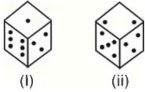
Number 3 is common to boththe figures (i) and (ii). The dice in fig. (ii) isassumed to be rotated so that 3 remains on the FR-RH face (that is, face I as per activity 1) and the numbers 5 and 2 move to the faces hidden behind the numbers 6 and 1respectively [in fig. (i)]. Thus, the combinedfigure will have 3 on FR-RH face (that is, faceI), 5 on RR-RH face (that is, face II), 2 onbottom face (that is, face VI), 1 on the topface (that is, face V) and 6 on FR-LH face (that is, face IV). Clearly, 2 lies opposite 1. Hence, when 2 is at the bottom , then 1 will be at the top.