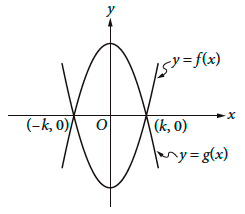
One can find the intersection points of the two graphs by setting the functions
f(x) and
g(x) equal to one another and then solving for
x. This yields
8x2−2=−8x2+2. Adding
8x2 and
2 to each side of the equation gives
16x2=4. Then dividing each side by
16 gives
x=± From the graph, the value of k is the
x−coordinate of the point of intersection on the positive x-axis. Therefore,
k=Alternatively, since
(k,0) lies on the graph of both f and g, it follows that
f(k)=g(k)=0. Thus, evaluating
f(x)=8x2−2 at
x=k gives
0=8k2−2. Adding
2 to each side yields
2=8k2 and then dividing each side by
8 gives
=k2.Taking the square root of each side then gives
k=±.From the graph, k is positive, so
k=Choices A, C, and D are incorrect and may be the result of calculation errors in solving for
x or
k