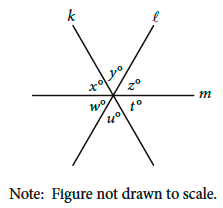
Since the angles marked
y∘ and
u° are vertical angles,
y=u.
Subtracting the sides of
y=u from the corresponding sides of
x+y=u+w gives
x=w.
Since the angles marked
w∘ and
z∘ are vertical angles,
w=z. Therefore,
x=z, and so I must be true.
The equation in II need not be true. For example, if
x=w=z=t=70 and
y=u=40,
then all three pairs of vertical angles in the figure have equal measure and the given condition
x+y=u+w holds.
But it is not true in this case that
y is equal to
w.
Therefore, II need not be true.
Since the top three angles in the figure form a straight angle, it follows that
x+y+z=180.
Similarly,
w+u+t=180, and so
x+y+z=w+u+t.
Subtracting the sides of the given equation
x+y=u+w from the corresponding sides of
x+y+z=w+u+t gives
z=t. Therefore, III must be true. Since only I and III must be true, the correct answer is choice B.
Choices A, C, and D are incorrect because each of these choices includes II, which need not be true.