Concept:To determine who sits to the immediate left of Z, the seating positions must be uniquely fixed.
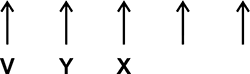
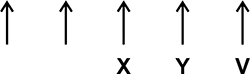
Explanation:Statement I alone:V and X are immediate neighbours of Y, and V is at an extreme end.
This forces Y to be next to V, but the remaining two people can take either order on the other side.
Possible arrangements:
V,Y,X,_,_ or
_,_,X,Y,V.
The position of Z is not fixed.
So Statement I alone is insufficient.
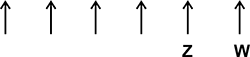
Statement II alone:Z sits to the immediate left of W, and W is at an extreme end.
Since W cannot be at the left extreme, W is at the right extreme.
So Z is fixed at position 4, but the left neighbour of Z can be V, X, or Y.
So Statement II alone is insufficient.
Combining both statements:From Statement II, W is at the right extreme and Z is immediately left of W.
From Statement I, V is at an extreme end and is a neighbour of Y, with X also a neighbour of Y.
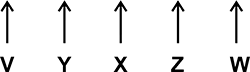
Using the remaining positions, the only possible arrangement is:
V,Y,X,Z,WThus, X sits to the immediate left of Z.
Therefore, statements I and II together are sufficient.
Answer:Option C: Data in statements I and II together are sufficient to answer the question.