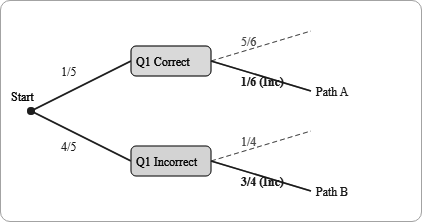
Concept:The problem uses the law of total probability combined with complementary events to find the probability of answering the second question incorrectly.Explanation:Let Q1 and Q2 represent the first and second questions respectively.Given: P(Q1 correct)=51.So, P(Q1 incorrect)=1−51=54.If Q1 is correct, P(Q2 correct)=65, so P(Q2 incorrect)=1−65=61.If Q1 is incorrect, P(Q2 correct)=41, so P(Q2 incorrect)=1−41=43.Now, apply the law of total probability:P(Q2 incorrect)=P(Q1 correct)×P(Q2 incorrect∣Q1 correct)+P(Q1 incorrect)×P(Q2 incorrect∣Q1 incorrect).Substituting the values:P(Q2 incorrect)=(51×61)+(54×43).This simplifies to 301+53.Writing with a common denominator: 301+3018=3019.
Answer:The probability that Chris will answer the second question incorrectly is 3019, which matches option A.