Concept:Ohm's law states that the potential difference
V across a conductor is directly proportional to the current
I flowing through it, provided the physical conditions such as temperature remain constant.
Explanation:According to Ohm's law,
V∝I, which gives
V=IR, where
R is the resistance of the conductor.
Rearranging the equation, we get
I=RV.
The rate of change of current with respect to potential is
dVdI=R1.
For an ohmic conductor,
R remains constant, so
dVdI also remains constant.
This means the
V−I graph is a straight line passing through the origin with a constant slope.
Ohm's law becomes invalid when the
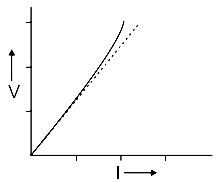
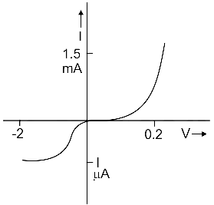
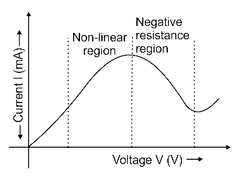
V−I relationship is non-linear, meaning the value of
dVdI changes with the applied potential.
Such non-ohmic behaviour is seen in devices like semiconductors, diodes, and transistors, where resistance varies with voltage and current.
Hence, Ohm's law fails when the rate of change of current with respect to potential is not constant.
Answer:Option B: Rate of change of current with respect to potential is not constant.