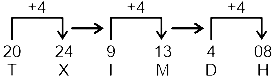
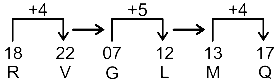
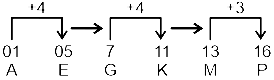
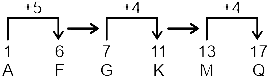
Concept:The relationship is based on the alphabet positions of the letters in each pair.
Each pair has a fixed difference between its two letters, and the gap between the first letters of consecutive pairs increases by 6.
Explanation:Use alphabet positions:
A=1,B=2,...,Z=26.
In the given triad
TX−IM−DH:
T=20,
X=24, so
X−T=4.
I=9,
M=13, so
M−I=4.
D=4,
H=8, so
H−D=4.
So, in every pair, the second letter is 4 places ahead of the first letter.
Now compare the first letters:
T(20)→I(9)→D(4).
The differences are
9−20=−11 and
4−9=−5.
Here,
−5−(−11)=6, so the difference increases by 6.
The same pattern appears for the second letters:
X(24)→M(13)→H(8), giving differences
−11 and
−5.
Now test the options using this pattern.
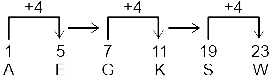
Option D:
AE−GK−SW.
Internal differences:
E−A=4,
K−G=4,
W−S=4.
First letters:
A(1)→G(7)→S(19); differences are
6 and
12, which increase by 6.
Second letters:
E(5)→K(11)→W(23); differences are
6 and
12, which also increase by 6.
Thus, option D follows the exact same logic as the given triad.
Answer:AE−GK−SW