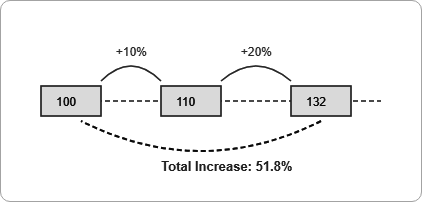
Concept:Successive percentage increases are combined by multiplying the decimal factors corresponding to each increase.
Explanation:An increase of
x% changes a number by the factor
(1+100x).
For
10%, the factor is
1+10010=1.10.
For
20%, the factor is
1+10020=1.20.
For
15%, the factor is
1+10015=1.15.
The net multiplying factor for all three successive increases is:
1.10×1.20×1.15Multiplying the first two factors:
1.10×1.20=1.32Now multiply this result by the third factor:
1.32×1.15=1.518This means the final value is
1.518 times the original value.
The overall percentage increase is found by:
(1.518−1)×100=0.518×100=51.8%So the number increases by
51.8% after all three successive increases.
Answer:The overall percentage increase is
51.8%.
Therefore, the correct option is A.
51.8%.