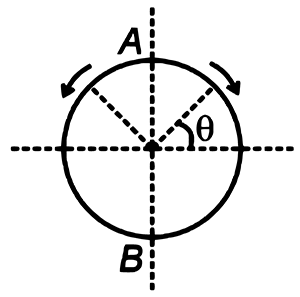
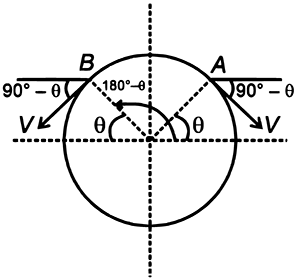
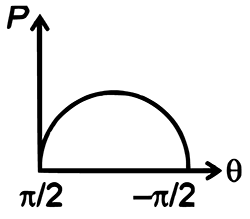
Concept:The net linear momentum is the vector sum of momenta of the two particles, which depends on their positions on the circular path.Explanation:Both particles have mass m=1 and uniform speed v.Let one particle move clockwise and the other anticlockwise from θ=π/2 to θ=−π/2.At an angle θ, their positions are symmetric about the vertical axis.The velocity vectors are tangential to the circle.For the particle on the right side, velocity components: vx=−vsinθ, vy=−vcosθ.For the particle on the left side, velocity components: vx=vsinθ, vy=−vcosθ.So net momentum: Pnet=(−vsinθ+vsinθ)i^+(−vcosθ−vcosθ)j^=−2vcosθj^.Magnitude: P=2v∣cosθ∣.At θ=π/2 and θ=−π/2, cosθ=0, so P=0.At θ=0, cosθ=1, so P=2v (maximum).So the graph of P vs θ is symmetric, starting at zero, rising to a peak at θ=0, then falling back to zero.
Answer:The graph that shows this shape (symmetric, zero at both ends, maximum at θ=0) is option B.