Formula used: Momentum of photonic radiation
p=cEMomentum transferred
Δp=pi−pfComplete step by step answer:
From the mass-energy equivalence, we have the energy of the photon given as
E=mc2, where
m is the energetic mass of the photon and
c is the velocity of light.
We know that the momentum of the photon can be expressed as
p=mc⇒E=(mc)c=pcThis means that the momentum possessed by a photon with energy E is:
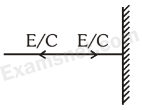
p=cEThere is a photon incident on a reflecting surface. The initial momentum of the photon is given as:
pi=cENow, the photon falls normally on a perfectly reflecting surface. This means that the photon is reflected back with the same magnitude of incident momentum but is directionally opposite.
The final momentum of the reflected photon is given as:
pf=−cEWe understand that the photon is able to reflect back after incidence because it imparts its momentum to the reflecting surface upon incidence. This momentum transferred between the photon and the reflecting surface will be equivalent to the change in momentum of the photon.
Therefore, the change in momentum of the photon is given as:
Δp=pi−pf=cE−(−cE)=cE+cE⇒Δp=c2EThis is equivalent to the momentum transferred by the incident photon to the reflecting surface which consequently brings about perfect reflection.