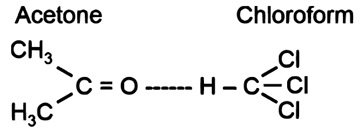
Concept:Negative deviation from Raoult's law occurs when intermolecular forces between unlike molecules in a mixture are stronger than those between like molecules in the pure components.
This reduces the escaping tendency of each component, lowering the vapour pressure below the ideal value.
Chemical Equation / Formula:Acetone:
CH3COCH3Chloroform:
CHCl3They form hydrogen bonds:
CHCl3⋯O=C(CH3)2.
Explanation:The oxygen atom of acetone is highly electronegative and can act as a hydrogen bond acceptor.
The hydrogen atom of chloroform is partially positive due to the electron‑withdrawing effect of three chlorine atoms, so it acts as a hydrogen bond donor.
Thus, a strong hydrogen bond forms between the O of acetone and the H of chloroform.
This interaction is stronger than the dipole‑dipole forces present in pure acetone or pure chloroform.
As a result, the molecules in the mixture are held more tightly, their escaping tendency decreases, and the vapour pressure becomes lower than expected from Raoult's law.
This is exactly the characteristic of a negative deviation.
The boiling point of the mixture therefore increases.
Option B correctly identifies the key cause: formation of hydrogen bonding between acetone and chloroform molecules.
Answer:Option B.