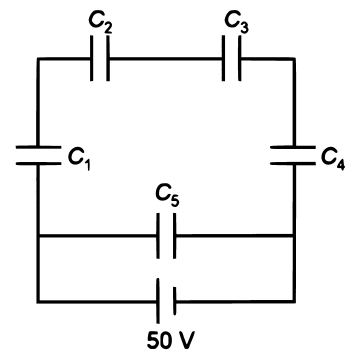
Concept:C1 (left arm),
C2 and
C3 (top arm) and
C4 (right arm) lie on one single conducting path between the two junctions at which
C5 is connected.
Hence
C1,
C2,
C3,
C4 are in series.
The portion of the loop below
C5 contains only connecting wires up to the battery, so
C5 is connected across the same two junctions as this series branch.
Therefore
C5 is in parallel with the series combination of
C1 to
C4, and the
50 V battery is applied across this parallel combination.
Formula:For series:
Cs1=C11+C21+C31+C41For parallel:
Ceq=Cs+C5Charge on a capacitor:
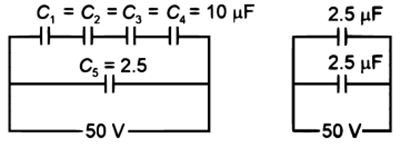
q=CVSolution:Cs=410=2.5 μFCeq=2.5+2.5=5 μFThe potential difference across each branch is
50 V.
Charge on the series branch:
q=CsV=2.5×50=125 μC.
Capacitors in series carry equal charge, so
C1,
C2,
C3,
C4 each receive
125 μC.
Charge on
C5:
q5=C5V=2.5×50=125 μC.
Thus all five capacitors carry the same charge,
125 μC.
(Check: total charge
=125+125=250 μC=CeqV=5×50, which is consistent.)
Answer:Option B:
5 μF and
125 μC on all capacitors.