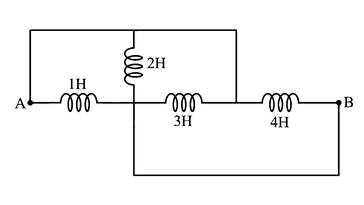
Concept:Inductors connected across the same pair of nodes are in parallel.
Explanation:Mark the two terminals as Node A and Node B.
A wire has zero resistance, so every point on the same continuous wire is at the same potential.
The top wire connects Node A, the top end of the 2 H inductor, and the junction near the 4 H inductor. Hence, all these points are at Node A.
The bottom wire connects the junction of the 1 H, 2 H, and 3 H inductors to Node B. Hence, all these points are at Node B.
Now check each inductor:
The 1 H inductor is connected between Node A and Node B.
The 2 H inductor is connected between Node A and Node B.
The 3 H inductor is connected between Node B and Node A.
The 4 H inductor is connected between Node A and Node B.
Therefore, all four inductors are connected across the same two terminals A and B, so they are in parallel.
For inductors in parallel:
Leq1=L11+L21+L31+L41Substitute the values:
Leq1=11+21+31+41The LCM of 1, 2, 3, and 4 is 12.
Leq1=1212+6+4+3=1225Taking the reciprocal:
Leq=2512HAnswer:The equivalent inductance between A and B is
2512H, which is option C.