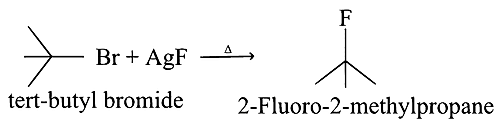
Concept:Tertiary alkyl halides undergo nucleophilic substitution through a carbocation intermediate by the
SN​1 mechanism.
Explanation:Silver fluoride (
AgF) provides a fluoride ion (
F−) and the silver ion (
Ag+) helps ionise the carbon–bromine bond.
tert-Butyl bromide,
(CH3​)3​C−Br, forms a stable tertiary carbocation,
(CH3​)3​C+.
The fluoride ion then attacks this carbocation to give the substitution product.
The reaction is:
(CH3​)3​C−Br+AgF→(CH3​)3​C−F+AgBrThe product is 2-fluoro-2-methylpropane, which is tert-butyl fluoride.
No rearrangement occurs because the tertiary carbocation is already highly stable.
Answer:The major product is 2-fluoro-2-methylpropane.
Correct option: B. 2-Fluoro-2-methylpropane.