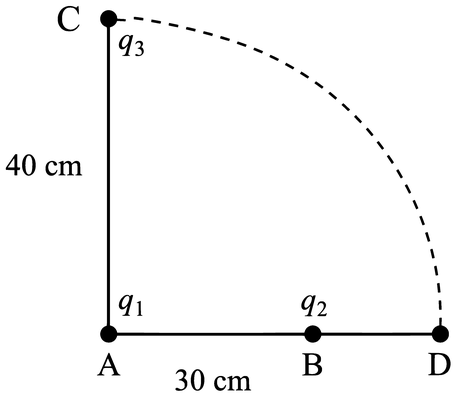
Concept:The electrostatic potential energy of q3 due to q1 and q2 is U=4πε01(r1q1q3+r2q2q3).The change in energy depends only on how the distances r1 and r2 change when q3 moves from C to D.Explanation:From the figure, AB=30 cm=0.3 m and AC=40 cm=0.4 m.Triangle ABC is right-angled at A, so BC=(0.3)2+(0.4)2=0.5 m.Thus, potential energy at C is UC=4πε0q3(0.4q1+0.5q2).When q3 moves along the circular path of radius 40 cm centered at A, AD=AC=0.4 m.Points A, B, and D are collinear, so BD=AD−AB=0.4−0.3=0.1 m.Thus, potential energy at D is UD=4πε0q3(0.4q1+0.1q2).The q1 terms cancel because AC=AD.So, ΔU=UD−UC=4πε0q3(0.1q2−0.5q2).This gives ΔU=4πε0q3q2(10−2)=4πε08q2q3.Comparing with the given form 4πε0q3k, we get k=8q2.Answer:k=8q2, so option A is correct.