Concept:A chiral carbon atom is one that is bonded to four different groups.
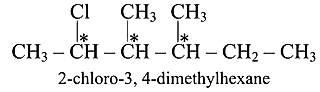
Explanation:The structure of 2-chloro-3,4-dimethylhexane is written as:
CH3​−CH(Cl)−CH(CH3​)−CH(CH3​)−CH2​−CH3​The parent chain has six carbon atoms numbered from 1 to 6.
At C2: The attached groups are
CH3​,
Cl,
H, and the C3-group.
All four groups are different, so C2 is chiral.
At C3: The attached groups are
CH3​,
H, the C2-group, and the C4-group.
The C2-group differs from the C4-group, so C3 is chiral.
At C4: The attached groups are
CH3​,
H, the C3-group, and the C5-group.
These four groups are different, so C4 is also chiral.
At C5: It is attached to two identical hydrogen atoms, so it is not chiral.
C1 and C6 are terminal carbons and therefore achiral.
Thus, the molecule contains exactly three chiral carbon atoms.
Answer:Three (Option C).