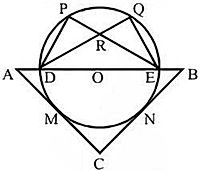
Concept:Angle in a semicircle is 90∘, angles on a straight line are supplementary, and vertically opposite angles are equal.Explanation:In the figure, A, D, E lie on a straight line.Therefore, ∠ADP+∠PDE=180∘.Given ∠ADP=100∘, we get ∠PDE=80∘.Since P lies on the circle and DE is the diameter, ∠DPE=90∘.In △PDE,∠PED=180∘−90∘−80∘=10∘.Also, ∠BEQ=100∘, and B,E,D are collinear.So, ∠QED=180∘−100∘=80∘.Since E,P,R are collinear and ray EP lies between EQ and ED,∠QER=∠QED−∠PED=80∘−10∘=70∘.Since DE is a diameter and Q lies on the circle, ∠DQE=90∘.As D,R,Q are collinear, ∠RQE=90∘.In △QRE,∠QRE=180∘−90∘−70∘=20∘.The lines PE and QD intersect at R; hence, ∠PRD and ∠QRE are vertically opposite angles.Thus, ∠PRD=∠QRE=20∘.Answer:∠PRD=20∘, i.e., option A.