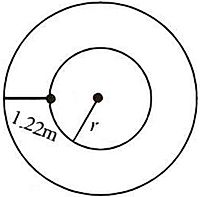
Concept:Both wheels are identical in height, so the distance travelled by a wheel is directly proportional to its number of revolutions.
The outer wheel follows a larger circle than the inner wheel.
Explanation:Let the radius of the inner circle be
r m.
Then the radius of the outer circle is
(r+1.22) m, because the axle tree is
1.22 m long.
The outer wheel makes
121=23 revolutions for every 1 revolution of the inner wheel.
Therefore, the distance travelled by the outer wheel is
23 times the distance travelled by the inner wheel.
Thus, we have:
2π(r+1.22)=23×2πrCancelling
2π from both sides:
r+1.22=23rr+1.22=1.5r1.22=0.5rr=2.44 mSo the radius of the outer circle is:
r+1.22=2.44+1.22=3.66 mCircumference of the circle described by the outer wheel:
2π×3.66=2×722×3.66=23 mAnswer:23 m, i.e., Option B.