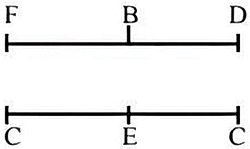
Concept:Use the fixed positions of D, F, B and E to determine the seating, then compare the opposite seats in the two rows.
Explanation:E is not at an end, so E sits in the middle seat of one row.
D is second to the left of F, so D and F occupy the two end seats of the other row.
B is the neighbour of F, so B must sit between D and F.
Hence one row is: D, B, F from left to right.
E is in the middle of the other row.
C is a neighbour of E and is diagonally opposite D, so C sits at the far end of E's row.
The second row becomes: A, E, C from left to right.
Arrangement:
Top row: A E C
Bottom row: D B F
In this arrangement, B is directly opposite E.
Answer:E sits opposite B, so the correct option is B (E).